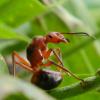
Gliding ants came up on one of the discords today. This is a good article on the topic.
https://www.berkeley...2/09_ants.shtml
A slightly more recent article (but old enough some videos don't work):
https://insider.si.e...unusual-flight/
Wiki article:
https://en.wikipedia...iki/Gliding_ant (was surprised to see Camponotus in the list ... though presumably only applies to arboreal Camponotus)
Cephalotes "turtle" ants are apparently the most famous of the gliding ants. When falling off a tree, they use visual cues to find the tree trunk, then glide backwards to it. If they bounce off they do a hairpin turn and try again.
Edited by OhNoNotAgain, November 12 2020 - 12:01 PM.
-
ConcordAntman and MinigunL5 like this
Past & Present
Veromessor pergandei, andrei, stoddardi; Novomessor cockerelli
Camponotus fragilis, Camponotus sansabeanus (inactive), vicinus, laevigatus/quercicola, CA02
Pogonomyrmex subnitidus, P. californicus (inactive)
Liometopum occidentale (inactive); Prenolepis imparis; Myrmecocystus mexicanus (inactive); Tetramorium sp. (inactive); Lasius sp.
Termites: Zootermopsis angusticollis, and a box of drywood termites that can't be seen
Isopods: (most no longer keeping) A. gestroi, granulatum, kluugi, maculatum, vulgare; C. murina; P. hoffmannseggi, P. haasi, P. ornatus; V. parvus, P. pruinosus, T. tomentosa
Spoods: (no longer keeping) Phidippus sp., other