Jump to content

  • Chat
  •  
  •  

Welcome to Formiculture.com!

This is a website for anyone interested in Myrmecology and all aspects of finding, keeping, and studying ants. The site and forum are free to use. Register now to gain access to all of our features. Once registered and logged in, you will be able to create topics, post replies to existing threads, give reputation points to your fellow members, get your own private messenger, post status updates, manage your profile and so much more. If you already have an account, login here - otherwise create an account for free today!

Photo

bmb1bee's Fossil Formicaria

formicaria fossil nest outworld shark teeth ammonite formica ants queen

  • Please log in to reply
13 replies to this topic

#1 Offline bmb1bee - Posted January 9 2026 - 10:51 PM

bmb1bee

    Advanced Member

  • Members
  • PipPipPip
  • 1,171 posts
  • LocationHayward, CA

*
POPULAR

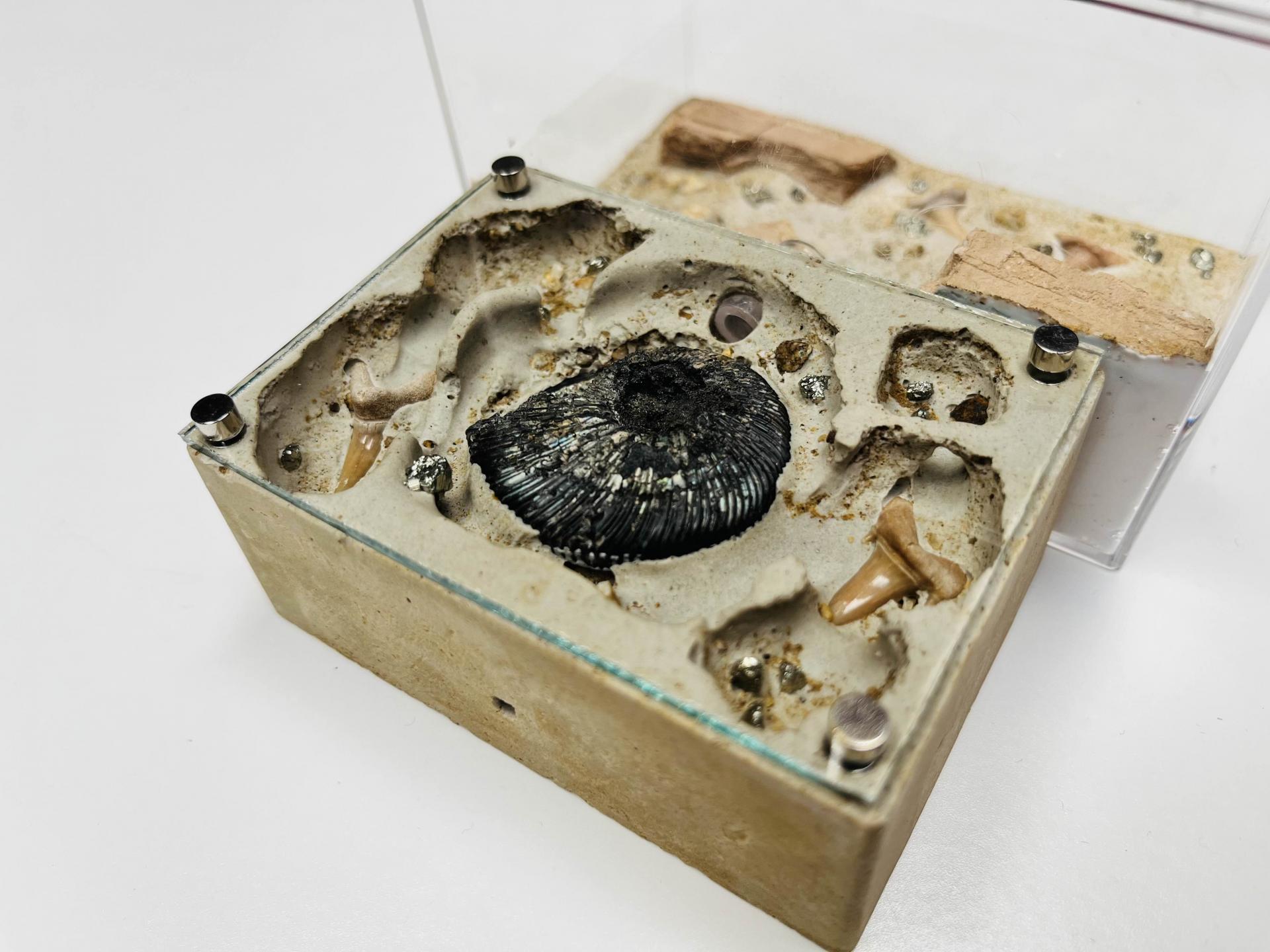
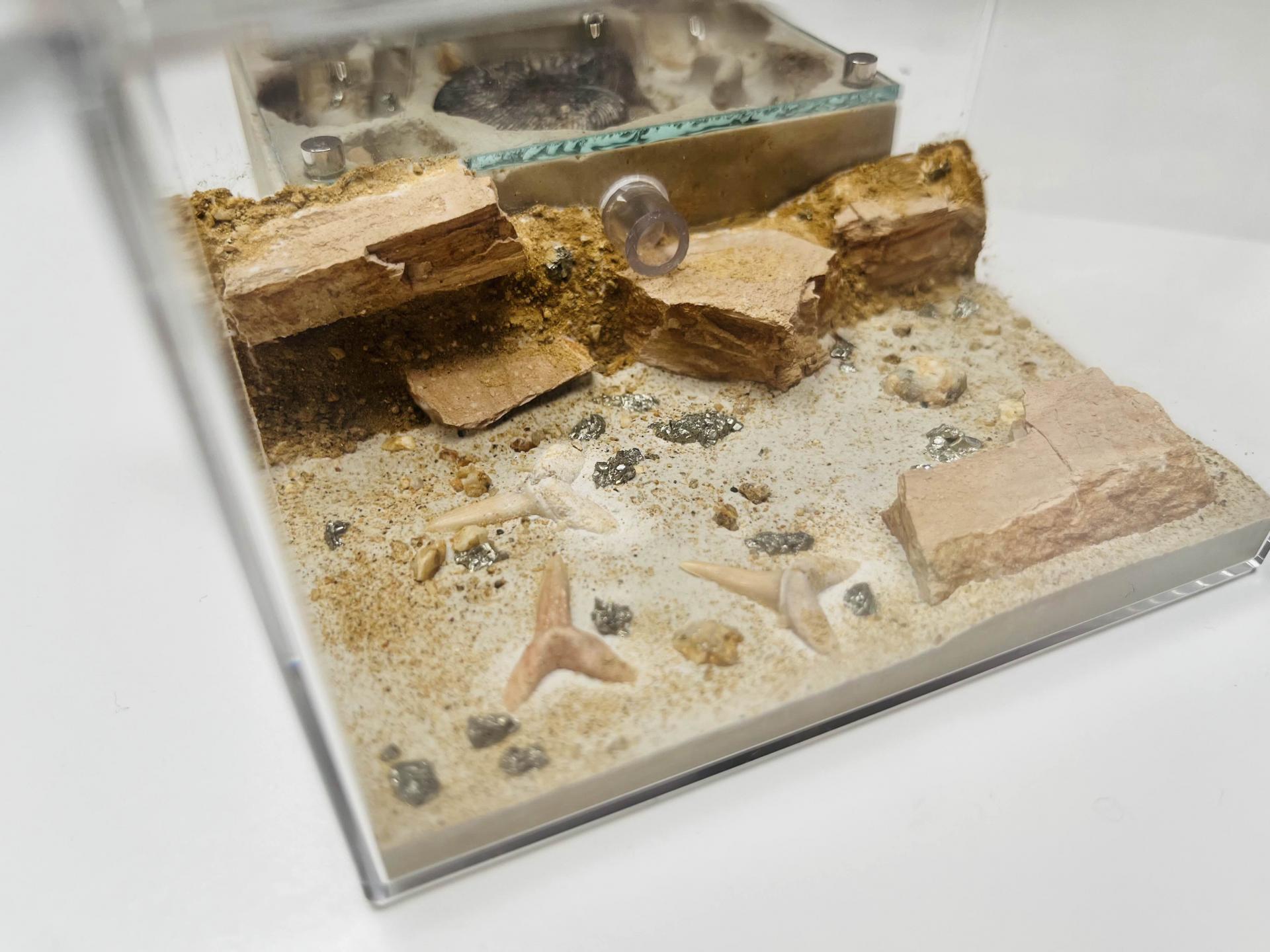
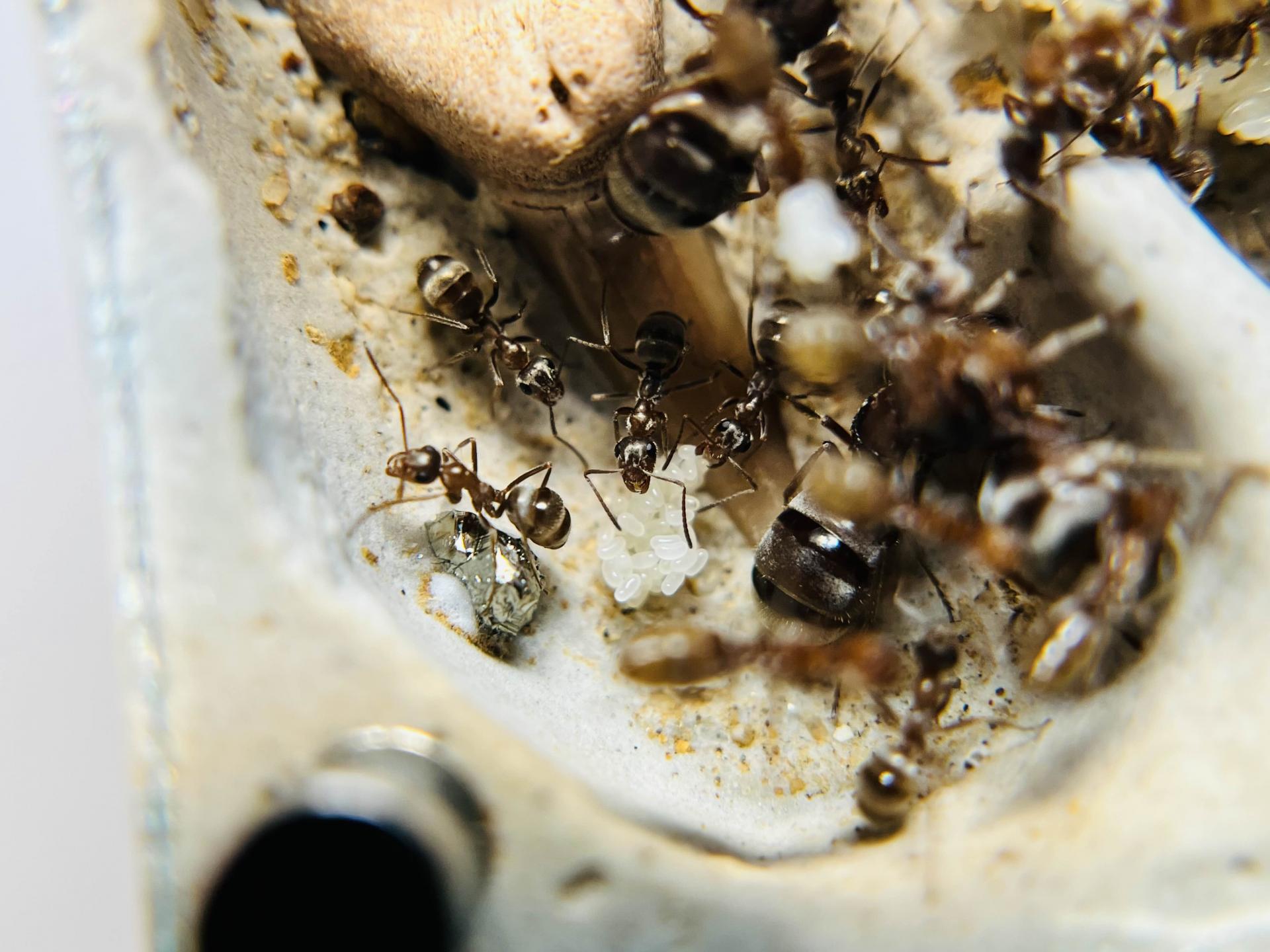
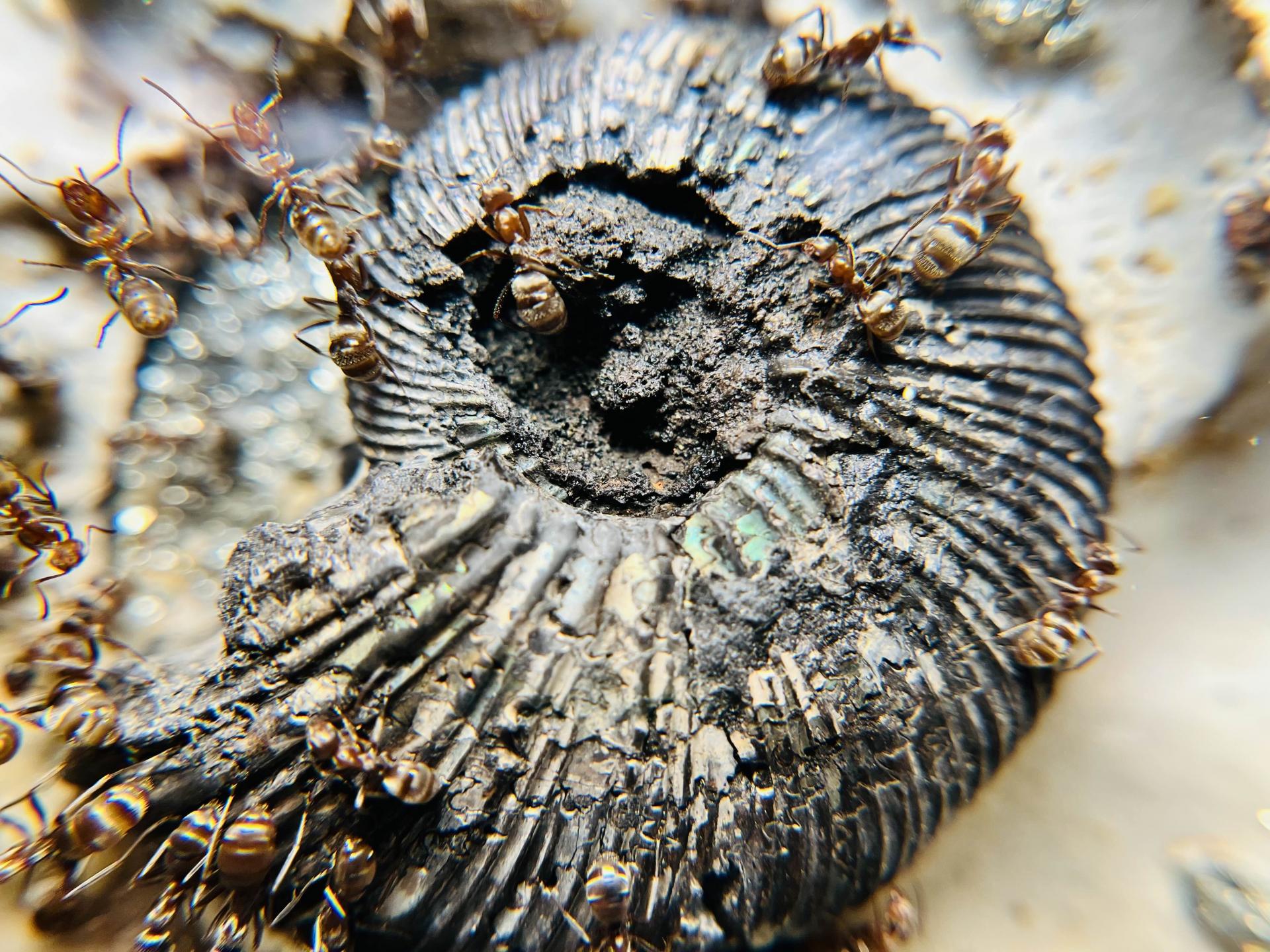
I was bored during my last couple weeks of winter break, so I decided to start some projects and commissions for making nests. While doing so, it occurred to me that since many people tend to add rocks and gems to their setups, why couldn't I add fossils? This nest was the result of combining bits of pyrite, chunks of shale, some shark teeth, and an ammonite... along with a bit of creativity of course. I'd really like to make more fossil-themed nests soon, especially for my other colonies. Once this Formica colony hits around a thousand workers, I plan to create a huge nest and outworld featuring an actual Otodus megalodon tooth. Future projects will likely include trilobites, more shark teeth, and ammonites.

Attached Images

  • IMG_2647.jpg
  • IMG_2650.jpg
  • IMG_2645.jpg
  • IMG_2672.jpg
  • IMG_2668.jpg
  • IMG_2674.jpg

Edited by bmb1bee, January 9 2026 - 10:55 PM.

  • Zeiss, ANTdrew, Ants_Dakota and 7 others like this

"Float like a butterfly sting like a bee, his eyes can't hit what the eyes can't see."
- Muhammad Ali

Check out my shop and Formica journal! Discord user is bmb1bee if you'd like to chat.

Also check out my YouTube channel: @bmb1bee


#2 Offline ANTdrew - Posted January 10 2026 - 2:57 AM

ANTdrew

    Advanced Member

  • Moderators
  • PipPipPip
  • 10,502 posts
  • LocationAlexandria, VA
That is a unique and beautiful design!
  • rptraut and bmb1bee like this
"The ants are a people not strong, yet they prepare their meat in the summer." Prov. 30:25
Keep ordinary ants in extraordinary ways.

#3 Online GOCAMPONOTUS - Posted January 10 2026 - 6:44 AM

GOCAMPONOTUS

    Advanced Member

  • Members
  • PipPipPip
  • 993 posts
  • LocationRocklin,CA

I nmy opinion the shark teeth are what bring it all together. Very nice.


  • bmb1bee likes this

Currently keeping: 2 C.vicinus colonies.2 C.sansabeanus. 1 C.leavissimus. 2 C.Ca02. 1 V.pergandei. 4 T.immigrans.1 F.pacifica. 1 C.hyatti

1 M.ergatognya


Trying to get my hands on :C.modoc,A.vercicolor, and Any Honeypots


#4 Offline bmb1bee - Posted January 10 2026 - 2:35 PM

bmb1bee

    Advanced Member

  • Members
  • PipPipPip
  • 1,171 posts
  • LocationHayward, CA

That is a unique and beautiful design!

Thanks! I plan to get even more creative with nest designs in the near future.


I nmy opinion the shark teeth are what bring it all together. Very nice.

Thanks to you too. I think the shark teeth were really compatible with the style I was trying to go for. I might try using some of those polished grey teeth for a future nest to see how well it looks.


  • GOCAMPONOTUS likes this

"Float like a butterfly sting like a bee, his eyes can't hit what the eyes can't see."
- Muhammad Ali

Check out my shop and Formica journal! Discord user is bmb1bee if you'd like to chat.

Also check out my YouTube channel: @bmb1bee


#5 Offline rptraut - Posted January 11 2026 - 12:27 AM

rptraut

    Advanced Member

  • Members
  • PipPipPip
  • 659 posts
  • LocationOntario, Canada
Hello bmb1bee;
 
I really like what you've created with the fossils in the nest and outworld and how it makes watching the ants so much more interesting.   I hope you don't mind if I show you an outworld I made a couple of years ago.   


IMG_8653.JPG
 
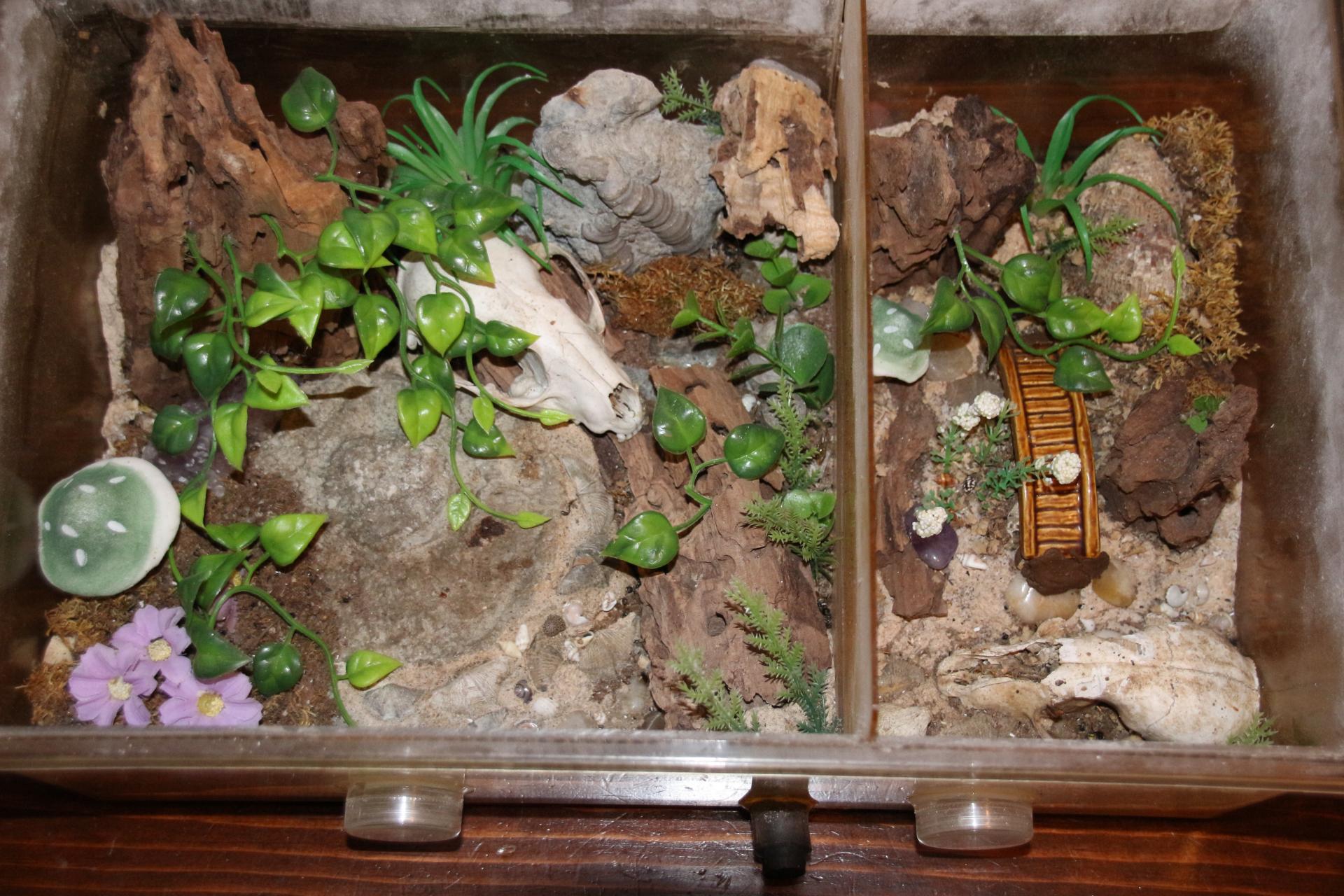
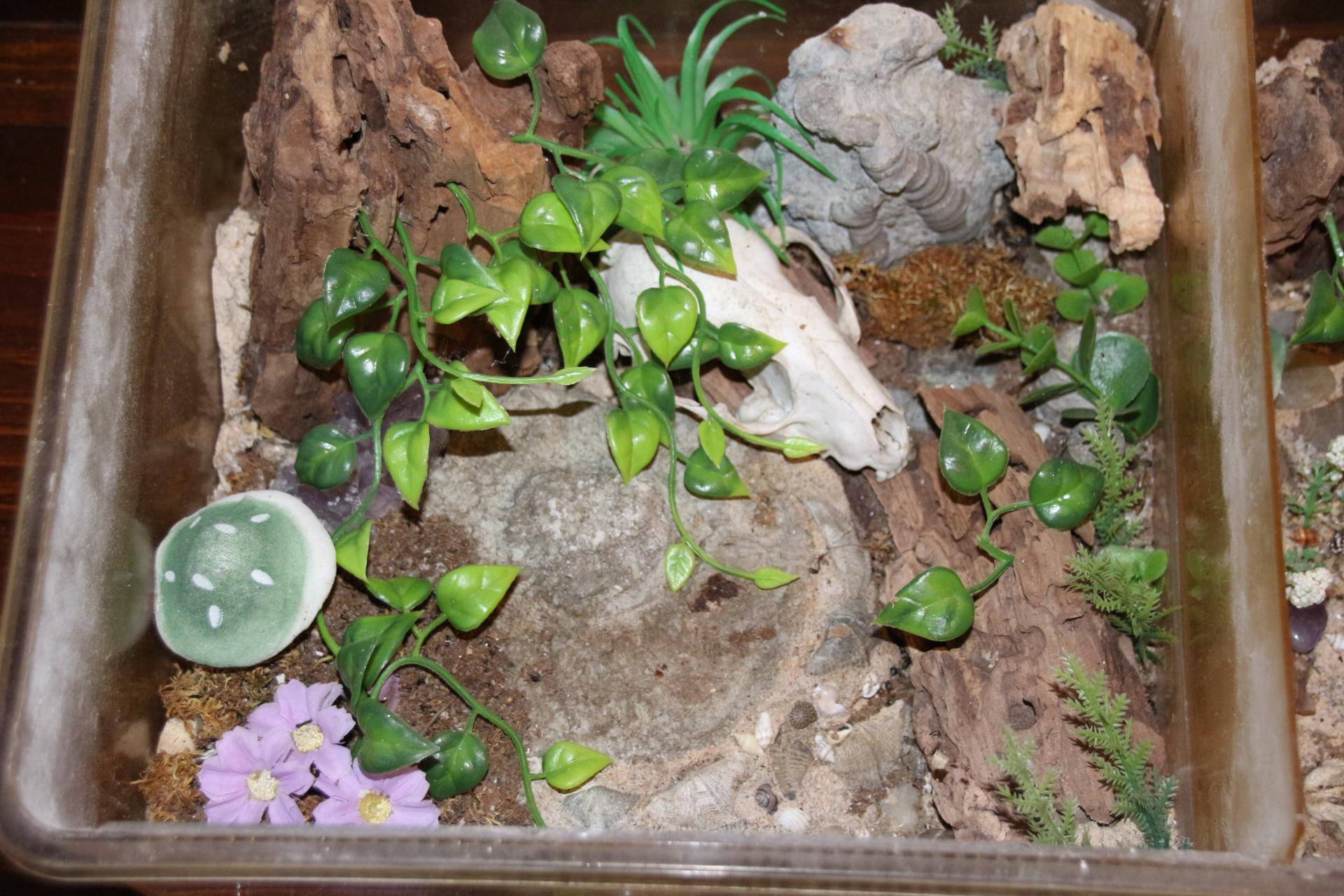
This outworld was made for a large Camponotus colony, I went all out and raided my fossil and shiny stone collection, along with plastic plants and parts of an old ant nest, I tried to create an outworld that would be interesting for the ants and for me.     I imbedded the fossils in the grout/vermiculite mixture that forms the base of this outworld.   The large fossil in the center made a convenient feeding platform. 


IMG_8652.JPG
 
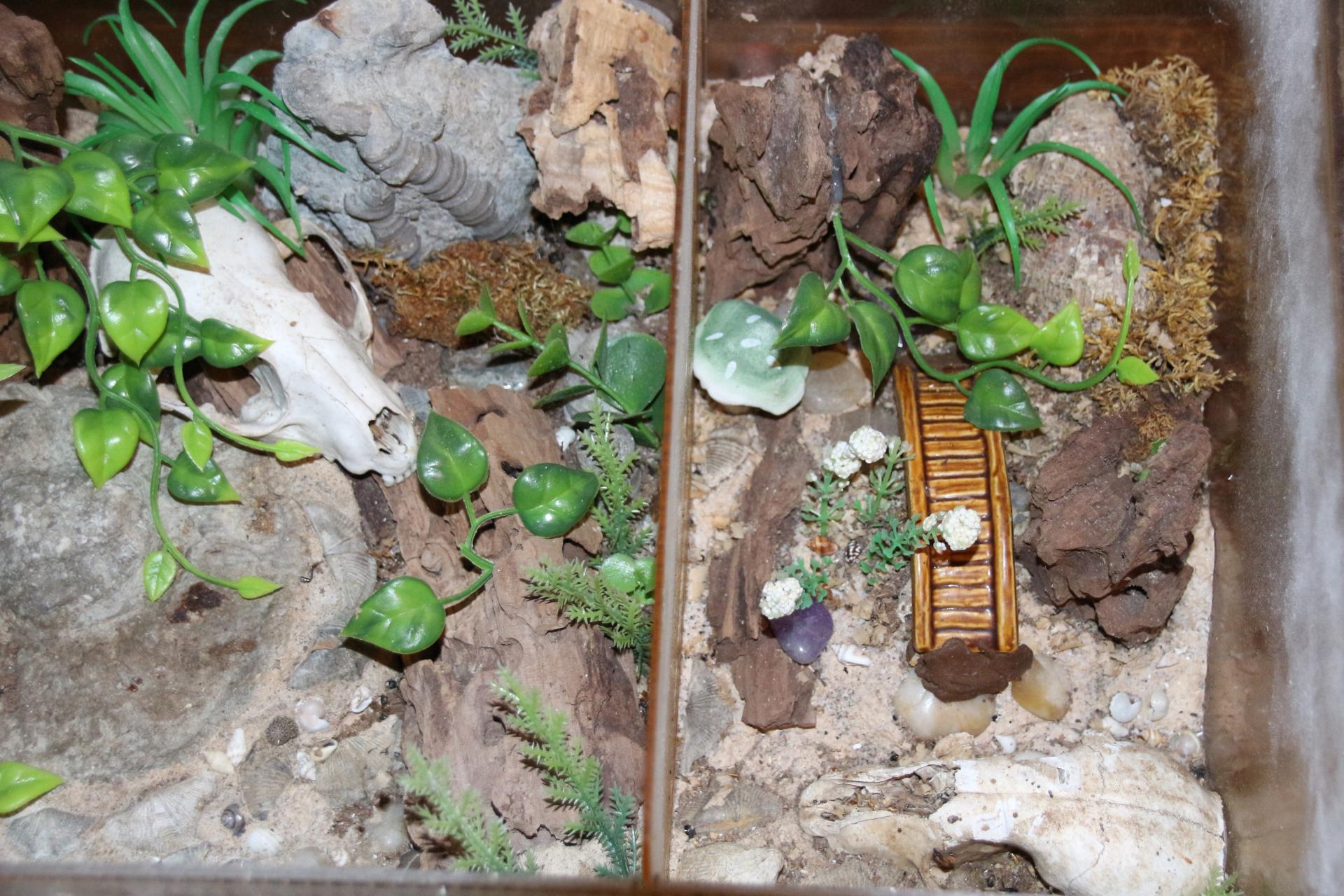
The skulls were a bonus, and the ants seem to like them as they often hid inside.   They'd drag food in there where they broke it apart and then took it into the nest.     They used the pieces of old ant nest like guard houses because I placed them at the entrances to the outworld from the nest and at the entrance to their sugar/water feeder.   


IMG_8654.JPG
 
This outworld is divided into two sections, I let them into the right, smaller side early in the season and then the larger side as well, later in the season as the colony size increased.   I was very interested to see how they took advantage of the opportunities to take command of the outworld with its many hiding places and places to use like command posts.   
 
I hope you get some ideas from this example.    I think complex outworlds give ants a more realistic natural experience and this gives them an opportunity to demonstrate more natural behaviours as they go about their activities.   They're certainly more interesting and entertaining for me to watch!
RPT 


  • ANTdrew, Ants_Dakota, bmb1bee and 2 others like this
My father always said I had ants in my pants.

#6 Offline bmb1bee - Posted January 11 2026 - 10:44 PM

bmb1bee

    Advanced Member

  • Members
  • PipPipPip
  • 1,171 posts
  • LocationHayward, CA

Hello bmb1bee;

 
I really like what you've created with the fossils in the nest and outworld and how it makes watching the ants so much more interesting.   I hope you don't mind if I show you an outworld I made a couple of years ago.   
 
This outworld was made for a large Camponotus colony, I went all out and raided my fossil and shiny stone collection, along with plastic plants and parts of an old ant nest, I tried to create an outworld that would be interesting for the ants and for me.     I imbedded the fossils in the grout/vermiculite mixture that forms the base of this outworld.   The large fossil in the center made a convenient feeding platform. 
 
The skulls were a bonus, and the ants seem to like them as they often hid inside.   They'd drag food in there where they broke it apart and then took it into the nest.     They used the pieces of old ant nest like guard houses because I placed them at the entrances to the outworld from the nest and at the entrance to their sugar/water feeder.   
 
This outworld is divided into two sections, I let them into the right, smaller side early in the season and then the larger side as well, later in the season as the colony size increased.   I was very interested to see how they took advantage of the opportunities to take command of the outworld with its many hiding places and places to use like command posts.   
 
I hope you get some ideas from this example.    I think complex outworlds give ants a more realistic natural experience and this gives them an opportunity to demonstrate more natural behaviours as they go about their activities.   They're certainly more interesting and entertaining for me to watch!
RPT 


I'm glad you liked it, and thanks so much for your tips! Feel free to share any ideas and creations you have, as you and other members have a lot more experience than I do. 


It's nice to see that other people have also thought of using fossils for their ants. I also thought that larger pieces of rocks and fossilized shells made for great, natural-looking feeding platforms. Using an outworld like that for Camponotus is a great choice in my opinion, since it seems to look especially nice with larger ants.


I have a couple mouse skulls from an owl pellet I intend to use in a future project, so it'll be pretty fun once I get around to it. It's cool that yours used it as a food-processing area.


I haven't split outworlds in two like that before, but it sounds like a really creative idea, especially for colonies that don't need the whole space just yet. 


I definitely learned a lot from your examples and I plan on hopefully being able to implement them in future projects. I also like watching my ants exploring new things I give them, which shows just how efficient problem-solvers they are. I hope to make some truly amazing outworlds and nests for all of my ants soon.


Thanks again,

BMB


  • rptraut and GOCAMPONOTUS like this

"Float like a butterfly sting like a bee, his eyes can't hit what the eyes can't see."
- Muhammad Ali

Check out my shop and Formica journal! Discord user is bmb1bee if you'd like to chat.

Also check out my YouTube channel: @bmb1bee


#7 Offline rptraut - Posted January 13 2026 - 12:08 AM

rptraut

    Advanced Member

  • Members
  • PipPipPip
  • 659 posts
  • LocationOntario, Canada

Hello bmb1bee;


I'm pleased you find my examples and comments helpful.    There are a number of elements I like to include in an outworld, you might want to consider how you might be able to incorporate them in yours.    First of all, when you put ants in natural setups like mine you have to realize you may no longer be able to view them as well as you can in a more open setup.     You're very correct that the Camponotus outworld shown above was ideal for the larger ants, but I still use natural setups for smaller ants, but I use a feeding platform like a rock or fossil to monitor the colonies growth and activity.    You can see more of my setups in my Journal located here    RPT's Journal - Page 3 - Ant Keeping Journals - Ants & Myrmecology Forum


IMG_7986.JPG


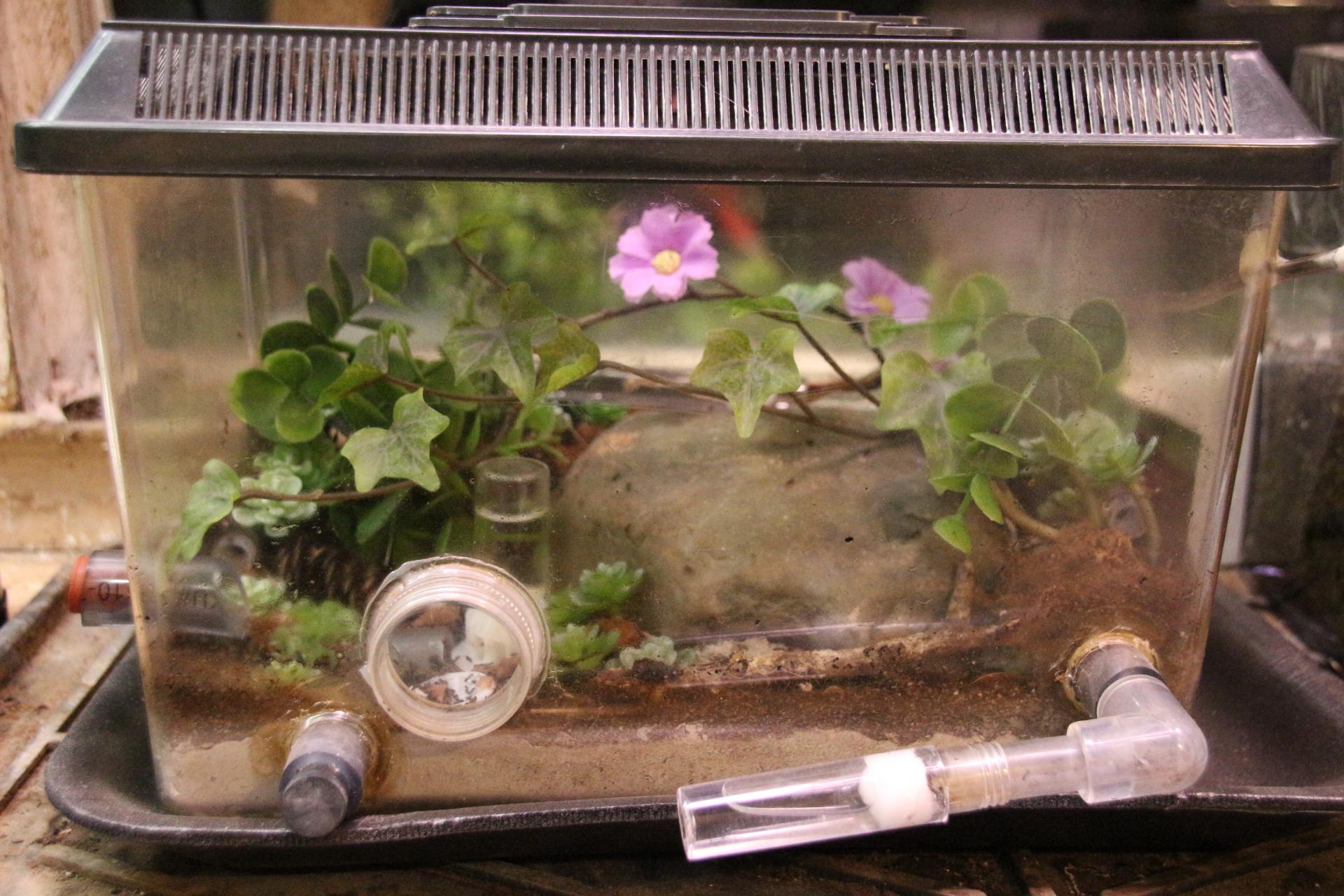
This is my Pet Rock Colony, a single large, heavy rock takes up most of the space in the container.   


IMG_7031.JPG


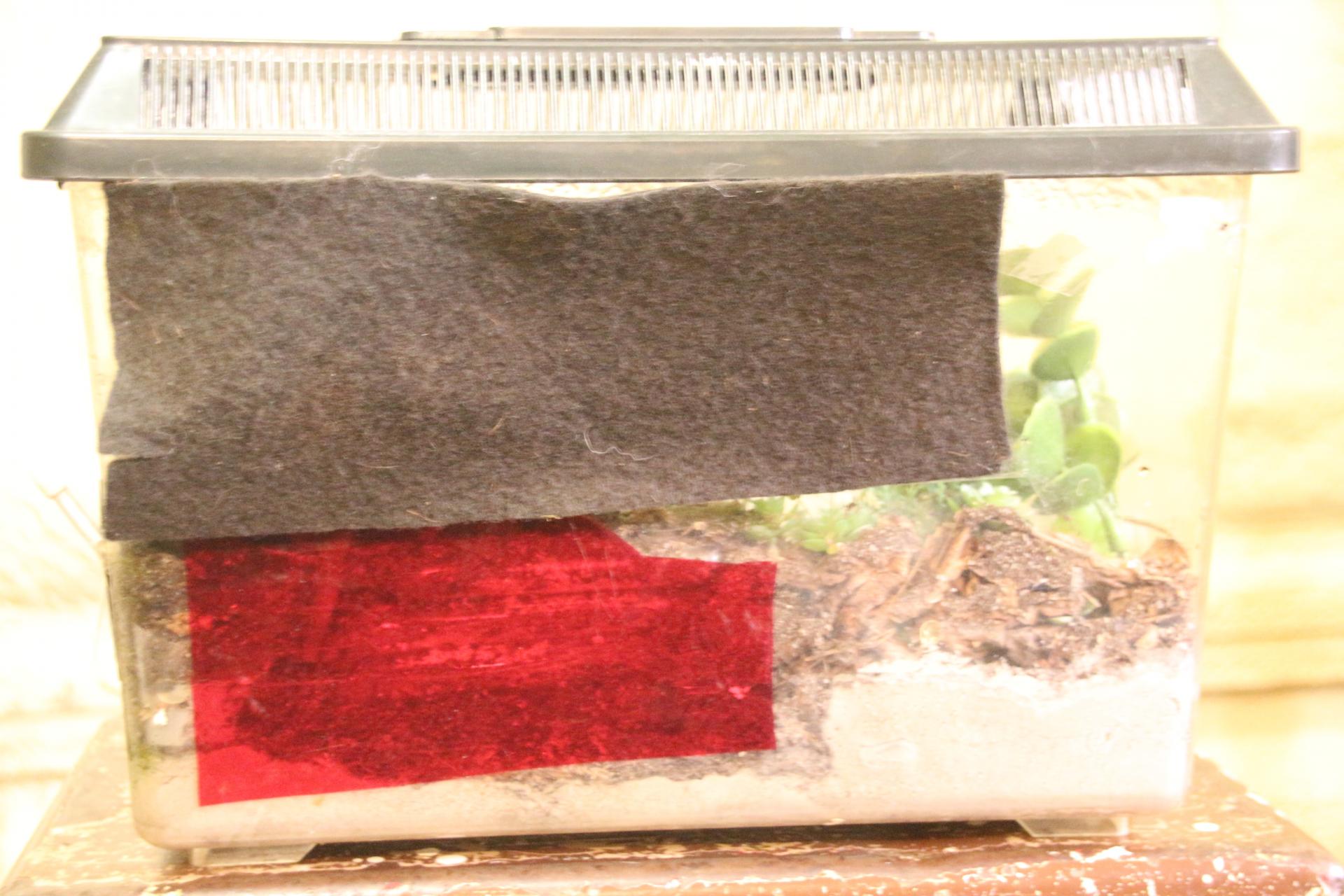
Test tubes placed between the rock and the back wall is a great place for ants to nest, the blackout cover is lifted in this photo.   


I use rocks, in one form or another, in most of my all-in-one setups and I often use a large rock in separate outworlds.    In nature, ants seem to like to nest near or under rocks, so I put small glass tubes between the rock and the acrylic wall, for the ants to nest in.    Ant colonies that enjoy heat are usually placed in a partly sunny window, with part of the setup shaded from the sun to provide a cool retreat on sunny days.    The rock absorbs a lot of heat, and this moderates the increase in the temperature of the colony, despite being in the sun.   That absorbed heat is released during the evening, and I often see ants out warming themselves on the rock and many ants mature their cocoons and pupae close to the heat.  For these reasons, I highly recommend the use of rocks in ant habitats.


IMG_7385.JPG


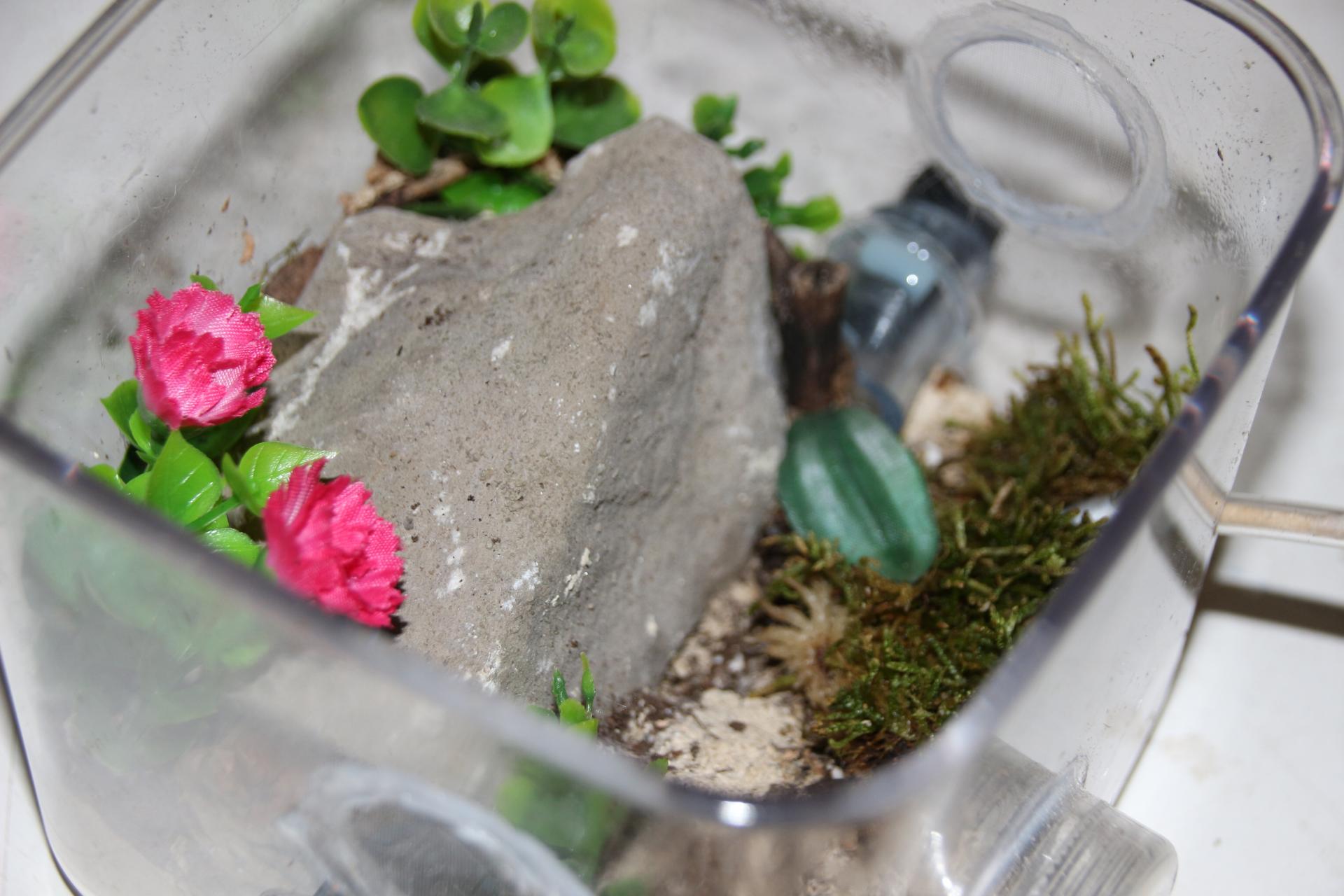
A rock can be added to any small setup like this one.   It also has an oasis on the right side.


Another important element in my setups and outworlds is an oasis.   This is an area I can keep wet to humidify the air in the setup.   I don't intend this area to provide drinking water for the ants, only humidity.     To make an oasis, it has to be the lowest part of the outworld, so when forming the grout/vermiculite mixture during construction, this area has no grout or shallow grout so any surface water in the area will flow into the oasis.   I've used a lot of materials to fill this low area, cotton, sponge, but the most effective has been vermiculite.   It absorbs water almost instantly so the risk of standing water that ants might drown in is eliminated.   I usually cover the vermiculite with live moss which makes the area easier to wet and adds to the natural effect.   You can see the oases in the Camponotus outworld, one is in the upper right corner of the small section, the other is in the bottom left corner of the larger section.   


IMG_7530.JPG


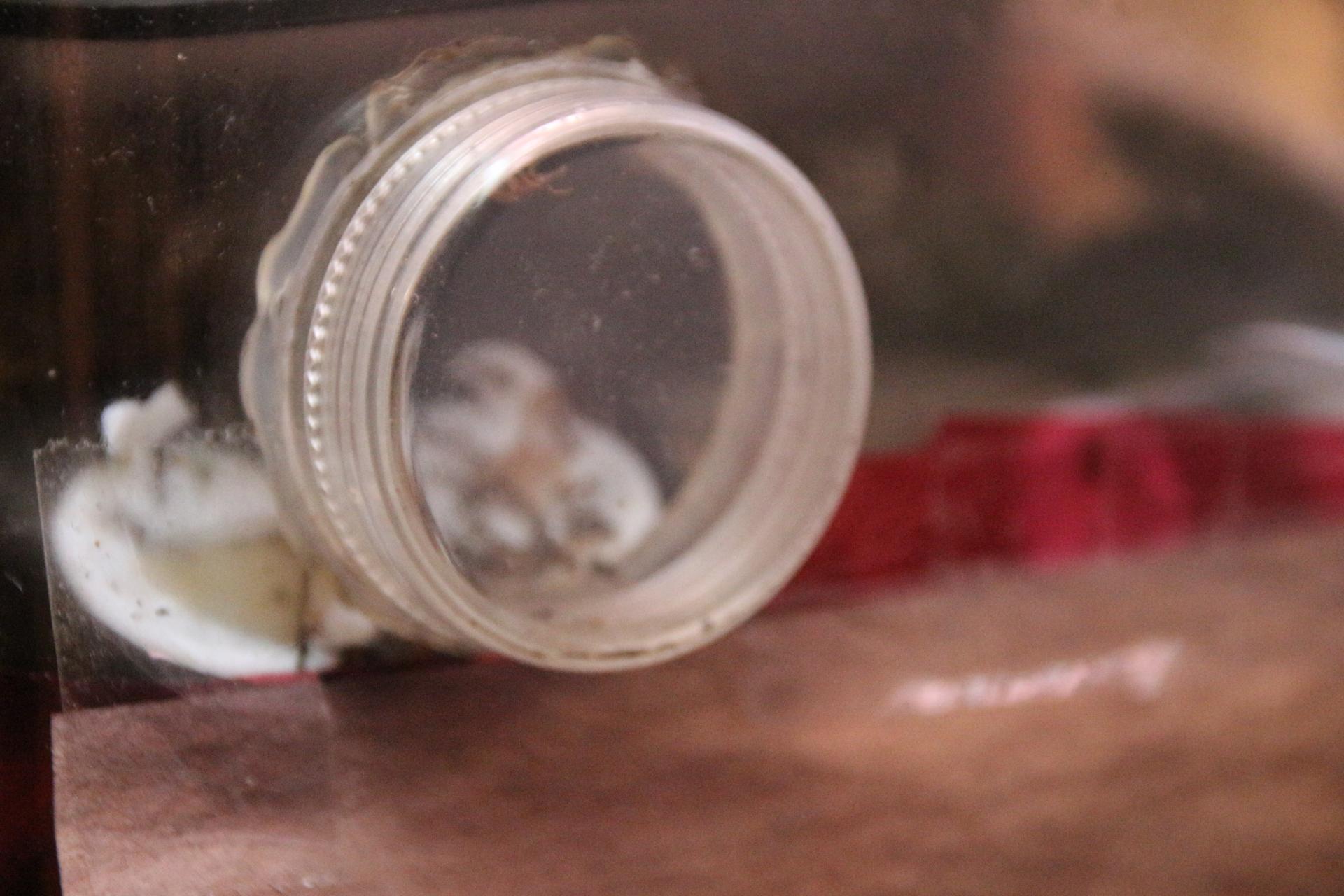
A feeding port is something you might consider for your outworlds to make feeding and cleaning easier.     You can find details about making one here   Make a Feeding Port - General Ant Keeping - Ants & Myrmecology Forum


Another important aspect of my setups is that they must be escape proof.    I find it easiest to use a completely closed container and provide ventilation with screened holes.    I do use some open top containers with an inside lid covered in talcum powder and heavy mineral oil on the walls.     Whatever the method, it must keep the ants in.   


I hope you find these examples helpful.   I look forward to seeing what you design.   

RPT  


Edited by rptraut, January 13 2026 - 12:21 AM.

  • Ants_Dakota and bmb1bee like this
My father always said I had ants in my pants.

#8 Offline bmb1bee - Posted January 13 2026 - 9:48 PM

bmb1bee

    Advanced Member

  • Members
  • PipPipPip
  • 1,171 posts
  • LocationHayward, CA

Hello bmb1bee;


I'm pleased you find my examples and comments helpful.    There are a number of elements I like to include in an outworld, you might want to consider how you might be able to incorporate them in yours.    First of all, when you put ants in natural setups like mine you have to realize you may no longer be able to view them as well as you can in a more open setup.     You're very correct that the Camponotus outworld shown above was ideal for the larger ants, but I still use natural setups for smaller ants, but I use a feeding platform like a rock or fossil to monitor the colonies growth and activity.    You can see more of my setups in my Journal located here    RPT's Journal - Page 3 - Ant Keeping Journals - Ants & Myrmecology Forum


This is my Pet Rock Colony, a single large, heavy rock takes up most of the space in the container.   


Test tubes placed between the rock and the back wall is a great place for ants to nest, the blackout cover is lifted in this photo.   


I use rocks, in one form or another, in most of my all-in-one setups and I often use a large rock in separate outworlds.    In nature, ants seem to like to nest near or under rocks, so I put small glass tubes between the rock and the acrylic wall, for the ants to nest in.    Ant colonies that enjoy heat are usually placed in a partly sunny window, with part of the setup shaded from the sun to provide a cool retreat on sunny days.    The rock absorbs a lot of heat, and this moderates the increase in the temperature of the colony, despite being in the sun.   That absorbed heat is released during the evening, and I often see ants out warming themselves on the rock and many ants mature their cocoons and pupae close to the heat.  For these reasons, I highly recommend the use of rocks in ant habitats.


A rock can be added to any small setup like this one.   It also has an oasis on the right side.


Another important element in my setups and outworlds is an oasis.   This is an area I can keep wet to humidify the air in the setup.   I don't intend this area to provide drinking water for the ants, only humidity.     To make an oasis, it has to be the lowest part of the outworld, so when forming the grout/vermiculite mixture during construction, this area has no grout or shallow grout so any surface water in the area will flow into the oasis.   I've used a lot of materials to fill this low area, cotton, sponge, but the most effective has been vermiculite.   It absorbs water almost instantly so the risk of standing water that ants might drown in is eliminated.   I usually cover the vermiculite with live moss which makes the area easier to wet and adds to the natural effect.   You can see the oases in the Camponotus outworld, one is in the upper right corner of the small section, the other is in the bottom left corner of the larger section.   


A feeding port is something you might consider for your outworlds to make feeding and cleaning easier.     You can find details about making one here   Make a Feeding Port - General Ant Keeping - Ants & Myrmecology Forum


Another important aspect of my setups is that they must be escape proof.    I find it easiest to use a completely closed container and provide ventilation with screened holes.    I do use some open top containers with an inside lid covered in talcum powder and heavy mineral oil on the walls.     Whatever the method, it must keep the ants in.   


I hope you find these examples helpful.   I look forward to seeing what you design.   

RPT  


Hi rptraut,


Firstly, I'd like to thank you for taking the time to reply. I like having good conversations like this, as this is what forums should be for (rather than arguing and harassing people online).


Thanks also for the link to your journal, I'll be sure to check it out. I've been thinking hard about a consistent style for my outworlds, but I'm aiming for something naturalistic but also open enough to view ants in. So far I think designs reflecting those of deserts, beaches, and riverbanks are a few good ones that would be compatible. They'd also be able to showcase smaller fossils like shark teeth and trilobites if I decide to add any later on. I'm definitely open to any suggestions or advice though.


The idea of having a large rock/fossil taking up most of the space in an outworld seems nice. That way I'd expend less of my ultracal mix and other resources like sand.


I usually make horizontal nests out of ultracal instead of having tubes in the outworld, but I do think for tubs and tubes setups I could implement the idea of using a rock to regulate heat. Since colonies nest under rocks in the wild, I think they'd probably like it like that.


An oasis would be a pretty cool idea, even if the nest already has some sort of hydration system. I'd likely have to make one for colonies that I plan to leave home during vacation, in case the main water tower dries out.


I do have some containers I can use as feeding ports, maybe I could try attaching them to the lids of my containers. It's a really neat concept which I see in a lot of setups people have.


For preventing escape, I have talcum powder and some PTFE-30 on hand. They're both working pretty well, so at this point I'm only worried about smaller ants like Pheidole being able to escape from cracks between any drilled holes and tubing. That can be fixed with a bit of tape or plastic wrap though.


Thanks again for your responses.

BMB


  • rptraut likes this

"Float like a butterfly sting like a bee, his eyes can't hit what the eyes can't see."
- Muhammad Ali

Check out my shop and Formica journal! Discord user is bmb1bee if you'd like to chat.

Also check out my YouTube channel: @bmb1bee


#9 Online GOCAMPONOTUS - Posted January 14 2026 - 8:35 PM

GOCAMPONOTUS

    Advanced Member

  • Members
  • PipPipPip
  • 993 posts
  • LocationRocklin,CA

JUSt read this journal , and it is very insightful. THank you for another great contribution RPT.


  • rptraut and bmb1bee like this

Currently keeping: 2 C.vicinus colonies.2 C.sansabeanus. 1 C.leavissimus. 2 C.Ca02. 1 V.pergandei. 4 T.immigrans.1 F.pacifica. 1 C.hyatti

1 M.ergatognya


Trying to get my hands on :C.modoc,A.vercicolor, and Any Honeypots


#10 Offline rptraut - Posted January 15 2026 - 12:34 AM

rptraut

    Advanced Member

  • Members
  • PipPipPip
  • 659 posts
  • LocationOntario, Canada

Hello bmb1bee and COCAMPONOTUS;


Thanks for your kind words, I'm glad you find my comments helpful.   I welcome your questions.

RPT


  • bmb1bee and GOCAMPONOTUS like this
My father always said I had ants in my pants.

#11 Offline rptraut - Posted January 16 2026 - 1:38 AM

rptraut

    Advanced Member

  • Members
  • PipPipPip
  • 659 posts
  • LocationOntario, Canada

Hello Everyone;


I have a few more thoughts about feeding chambers that you might find interesting.    bmb1bee, your idea of putting a feeding port on the top of a feeding chamber is a good one, especially with larger colonies where escape during feeding is a constant problem.     A feeding port on the front does have some advantages, in certain situations.    With small colonies, and shy ants, escape while feeding isn't much of a concern and when formicaria are on narrow shelves, feeding from the top can be awkward.    I find feeding from the front of the setup is practical if you're keeping a lot of small colonies.   


With larger colonies and when keeping ants that are determined to escape while feeding, a feeding port on the top allows some form of escape prevention to be applied to the underside of the lid, making access to the feeding port by ants impossible.    I use heavy mineral oil on the inside of my lids.    I haven't seen an ant yet that's been able to walk upside down across that slick surface.    This makes feeding my large Tetramorium and Camponotus colonies much easier.   


IMG_8416.JPG


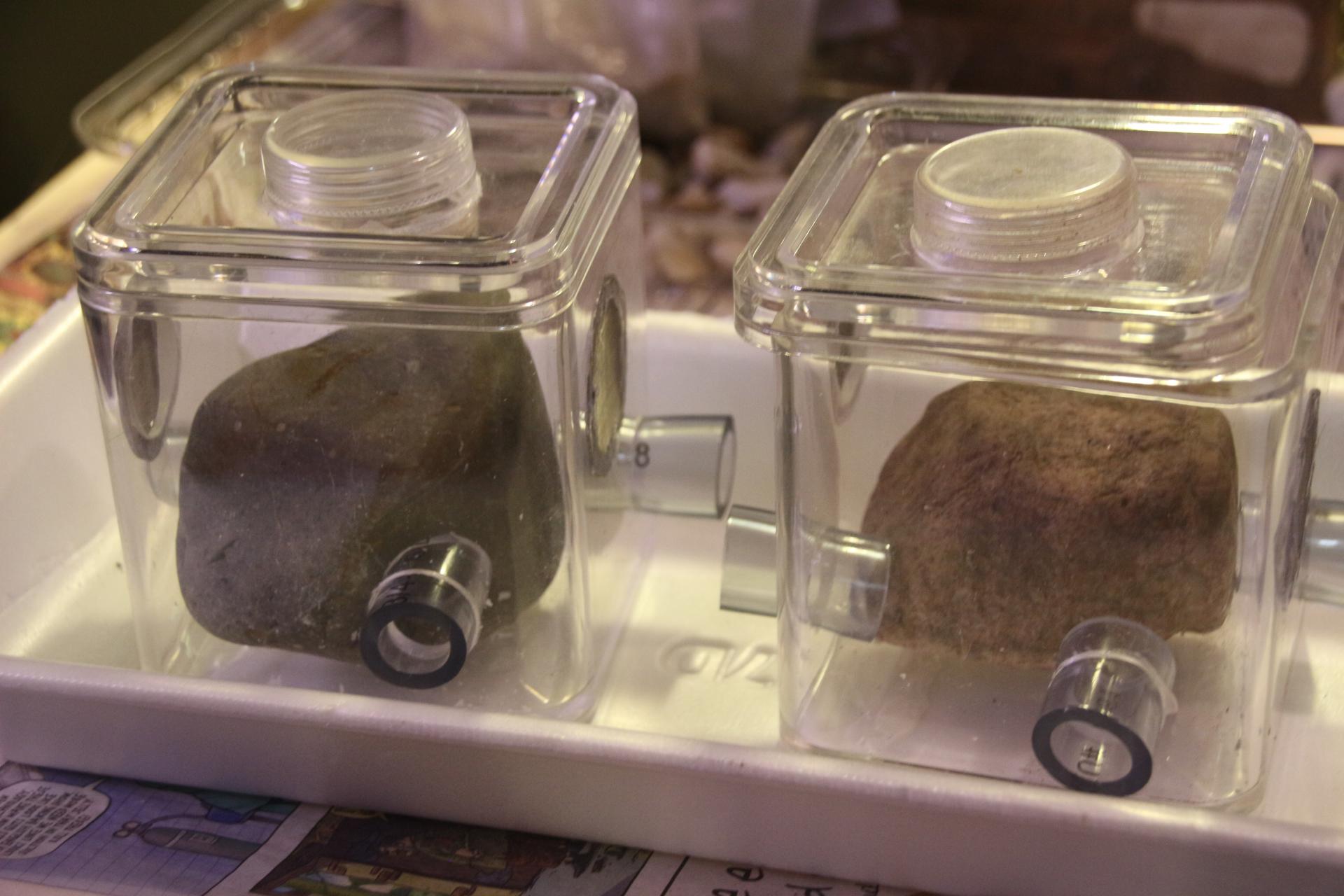
Here's a couple of feeding chambers during construction.   I put a feeding port on top of each one and a flat-topped rock was installed as a feeding platform.    My idea was to keep all trash in the feeding chamber, so I cut the tubing to fit tightly around the rock.   I left enough room to let ants pass through, but something like a fly or cricket can't.    This keeps any trash in one module and it's easy to clean up.


IMG_8461.JPG


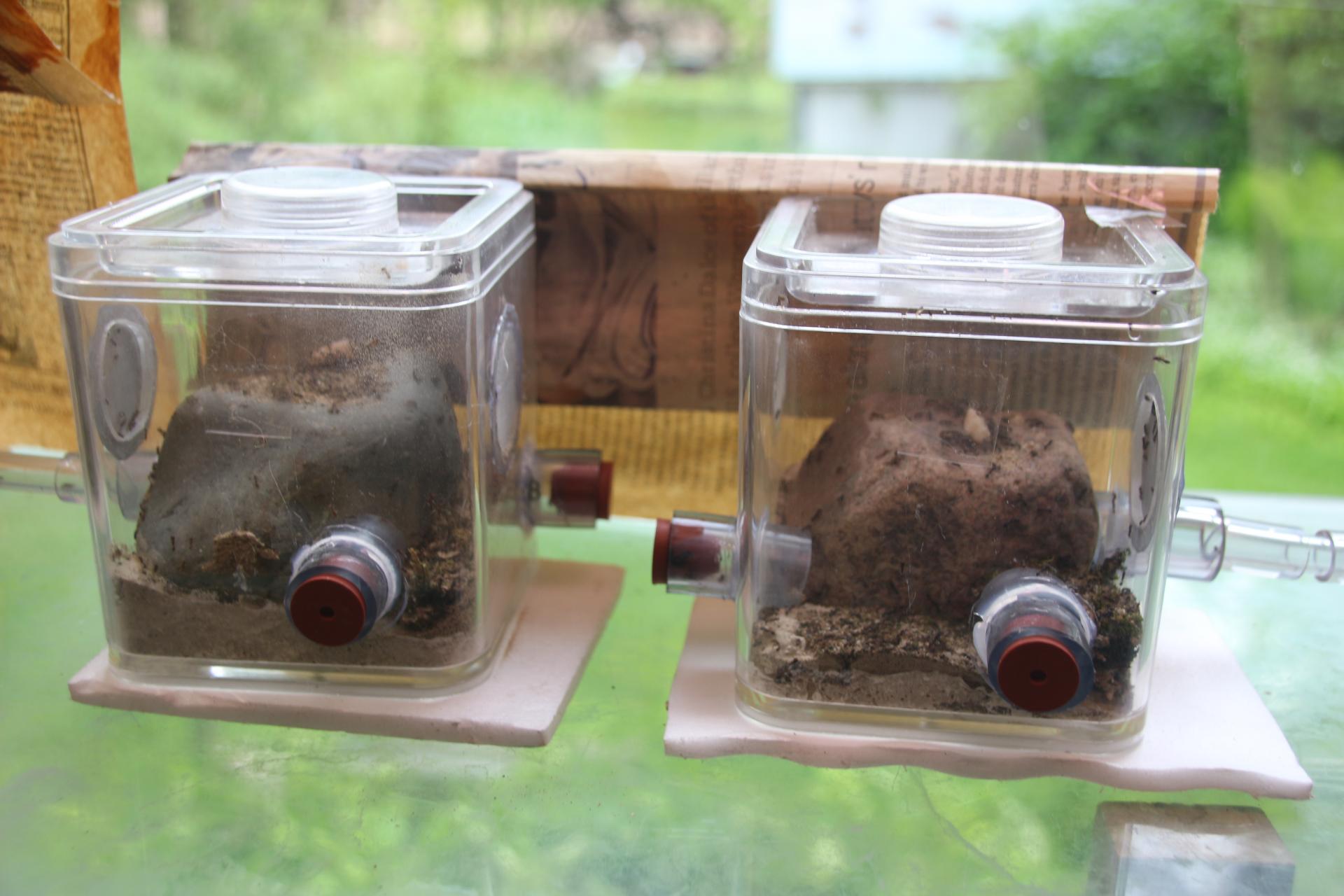
These are the same feeding chambers attached to my two Tetramorium colonies.    I put them close together to make feeding both colonies easier.     These colonies are roughly the same size, and I feed them the same things so feeding takes only a few minutes.    For clean up, I quickly remove the lid and apply a coating of mineral oil around the top edge that temporarily stops the rush for the open top, and then I can vacuum out any waste.    I don't really vacuum very often because I feed mostly meat products that the ants clean up completely - no trash.  


IMG_8465.JPG


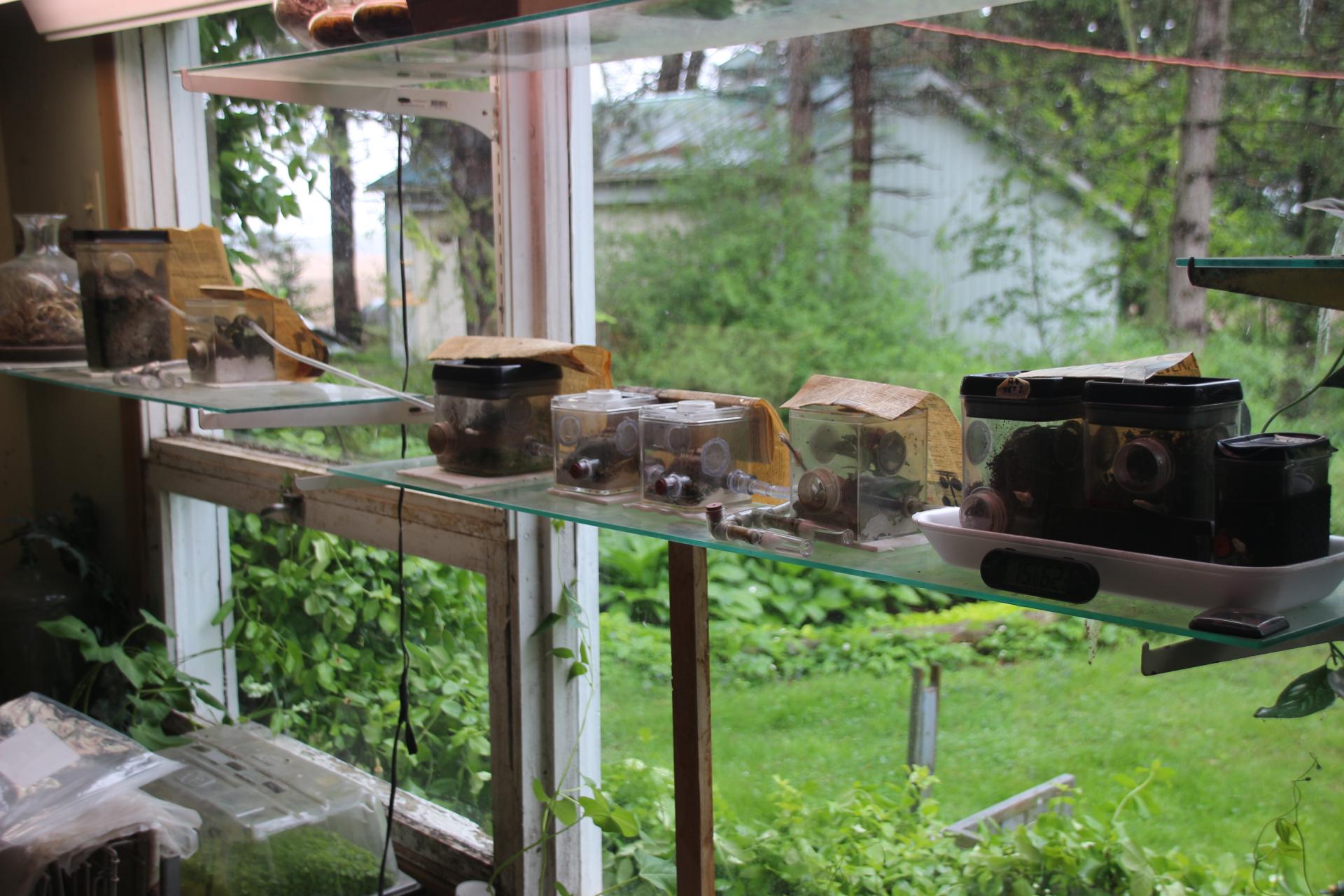
Here you can see the two colonies on their window shelf.    The feeding chambers are in the middle, one colony is comprised of the modules to the left and the other, the modules to the right.    The newspaper shades keep the chambers from overheating in the sun and provides a cooler area for brood rearing.   


IMG_8123.JPG


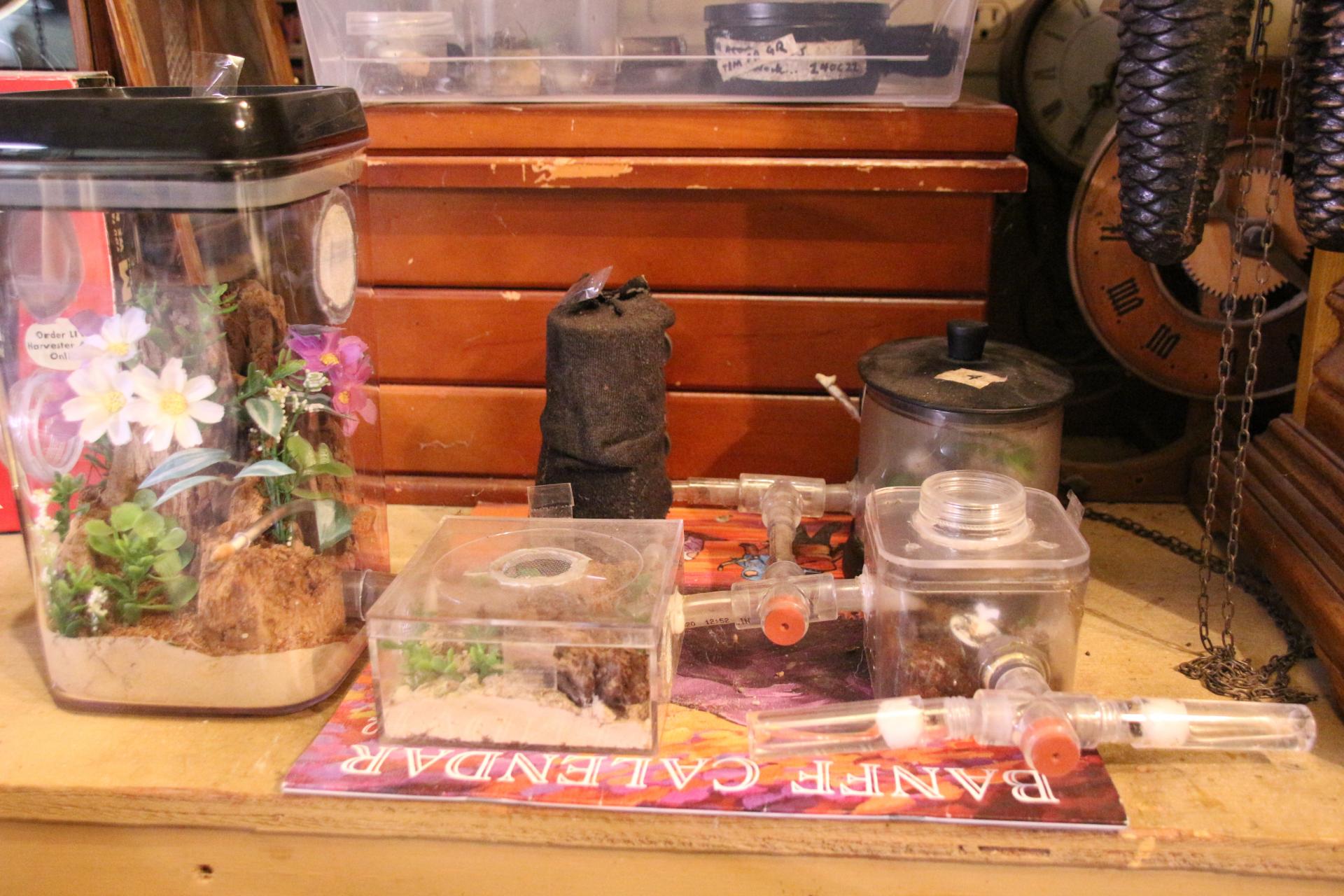
This setup houses one large Camponotus colony.     The feeding chamber at the right front is where I feed protein, and they also receive sugar/water and water in the tubes mounted on either side.     Feeding a colony is very easy with this setup.


I hope these examples give you some ideas to incorporate into your outworlds and feeding chambers.    I find they make feeding and cleaning my ants much easier and quicker, making ant keeping that much more enjoyable.   

RPT


  • bmb1bee likes this
My father always said I had ants in my pants.

#12 Online GOCAMPONOTUS - Posted January 16 2026 - 5:14 AM

GOCAMPONOTUS

    Advanced Member

  • Members
  • PipPipPip
  • 993 posts
  • LocationRocklin,CA

Hello Everyone;


I have a few more thoughts about feeding chambers that you might find interesting.    bmb1bee, your idea of putting a feeding port on the top of a feeding chamber is a good one, especially with larger colonies where escape during feeding is a constant problem.     A feeding port on the front does have some advantages, in certain situations.    With small colonies, and shy ants, escape while feeding isn't much of a concern and when formicaria are on narrow shelves, feeding from the top can be awkward.    I find feeding from the front of the setup is practical if you're keeping a lot of small colonies.   


With larger colonies and when keeping ants that are determined to escape while feeding, a feeding port on the top allows some form of escape prevention to be applied to the underside of the lid, making access to the feeding port by ants impossible.    I use heavy mineral oil on the inside of my lids.    I haven't seen an ant yet that's been able to walk upside down across that slick surface.    This makes feeding my large Tetramorium and Camponotus colonies much easier.   


attachicon.gifIMG_8416.JPG


Here's a couple of feeding chambers during construction.   I put a feeding port on top of each one and a flat-topped rock was installed as a feeding platform.    My idea was to keep all trash in the feeding chamber, so I cut the tubing to fit tightly around the rock.   I left enough room to let ants pass through, but something like a fly or cricket can't.    This keeps any trash in one module and it's easy to clean up.


attachicon.gifIMG_8461.JPG


These are the same feeding chambers attached to my two Tetramorium colonies.    I put them close together to make feeding both colonies easier.     These colonies are roughly the same size, and I feed them the same things so feeding takes only a few minutes.    For clean up, I quickly remove the lid and apply a coating of mineral oil around the top edge that temporarily stops the rush for the open top, and then I can vacuum out any waste.    I don't really vacuum very often because I feed mostly meat products that the ants clean up completely - no trash.  


attachicon.gifIMG_8465.JPG


Here you can see the two colonies on their window shelf.    The feeding chambers are in the middle, one colony is comprised of the modules to the left and the other, the modules to the right.    The newspaper shades keep the chambers from overheating in the sun and provides a cooler area for brood rearing.   


attachicon.gifIMG_8123.JPG


This setup houses one large Camponotus colony.     The feeding chamber at the right front is where I feed protein, and they also receive sugar/water and water in the tubes mounted on either side.     Feeding a colony is very easy with this setup.


I hope these examples give you some ideas to incorporate into your outworlds and feeding chambers.    I find they make feeding and cleaning my ants much easier and quicker, making ant keeping that much more enjoyable.   

RPT

I like that idea myself, i Might try it out.


  • rptraut likes this

Currently keeping: 2 C.vicinus colonies.2 C.sansabeanus. 1 C.leavissimus. 2 C.Ca02. 1 V.pergandei. 4 T.immigrans.1 F.pacifica. 1 C.hyatti

1 M.ergatognya


Trying to get my hands on :C.modoc,A.vercicolor, and Any Honeypots


#13 Offline bmb1bee - Posted January 18 2026 - 12:15 AM

bmb1bee

    Advanced Member

  • Members
  • PipPipPip
  • 1,171 posts
  • LocationHayward, CA

Hello Everyone;


I have a few more thoughts about feeding chambers that you might find interesting.    bmb1bee, your idea of putting a feeding port on the top of a feeding chamber is a good one, especially with larger colonies where escape during feeding is a constant problem.     A feeding port on the front does have some advantages, in certain situations.    With small colonies, and shy ants, escape while feeding isn't much of a concern and when formicaria are on narrow shelves, feeding from the top can be awkward.    I find feeding from the front of the setup is practical if you're keeping a lot of small colonies.   


With larger colonies and when keeping ants that are determined to escape while feeding, a feeding port on the top allows some form of escape prevention to be applied to the underside of the lid, making access to the feeding port by ants impossible.    I use heavy mineral oil on the inside of my lids.    I haven't seen an ant yet that's been able to walk upside down across that slick surface.    This makes feeding my large Tetramorium and Camponotus colonies much easier.   


Here's a couple of feeding chambers during construction.   I put a feeding port on top of each one and a flat-topped rock was installed as a feeding platform.    My idea was to keep all trash in the feeding chamber, so I cut the tubing to fit tightly around the rock.   I left enough room to let ants pass through, but something like a fly or cricket can't.    This keeps any trash in one module and it's easy to clean up.


These are the same feeding chambers attached to my two Tetramorium colonies.    I put them close together to make feeding both colonies easier.     These colonies are roughly the same size, and I feed them the same things so feeding takes only a few minutes.    For clean up, I quickly remove the lid and apply a coating of mineral oil around the top edge that temporarily stops the rush for the open top, and then I can vacuum out any waste.    I don't really vacuum very often because I feed mostly meat products that the ants clean up completely - no trash.  


Here you can see the two colonies on their window shelf.    The feeding chambers are in the middle, one colony is comprised of the modules to the left and the other, the modules to the right.    The newspaper shades keep the chambers from overheating in the sun and provides a cooler area for brood rearing.   


This setup houses one large Camponotus colony.     The feeding chamber at the right front is where I feed protein, and they also receive sugar/water and water in the tubes mounted on either side.     Feeding a colony is very easy with this setup.


I hope these examples give you some ideas to incorporate into your outworlds and feeding chambers.    I find they make feeding and cleaning my ants much easier and quicker, making ant keeping that much more enjoyable.   

RPT

Hi RPT,


I agree that a forward-facing feeding port is pretty practical for smaller colonies kept on narrower shelves. It probably also works well for setups where you'd have to stack containers on top of each other to save space, which you can't make top-facing feeding ports for. I think a good middle ground would be a smaller-sized feeding port facing the front, but placed closer to the lid. There would then be enough room to place some sort of barrier on the side and food could still be placed in the outworld. Most of my setups are pretty basic though, where I either open the lid to drop food in or abandon a lid completely.


Your idea of leaving just enough room for the ants to pass through without taking the whole feeder insect with them is a really good one. I often have problems with mold as colonies would sometimes place parts of insect skeletons in their nest as they process it. Dragging the feeder inside to process it is also messy and can sometimes discolor the chambers in the nest. To deal with that, I sometimes just move trash back into the outworld so that they recognize where their refuse piles should be. 


The module setups are pretty nice. I've seen them used for some ants like leafcutters, but hadn't thought of making something like that for my ants before.


I'll be sure to test some of these ideas out with my setups. Perhaps that'd make my routine with ants a lot quicker and give me time to handle more colonies.


Thanks so much for your time,

BMB


  • rptraut likes this

"Float like a butterfly sting like a bee, his eyes can't hit what the eyes can't see."
- Muhammad Ali

Check out my shop and Formica journal! Discord user is bmb1bee if you'd like to chat.

Also check out my YouTube channel: @bmb1bee


#14 Offline rptraut - Posted Yesterday, 11:51 PM

rptraut

    Advanced Member

  • Members
  • PipPipPip
  • 659 posts
  • LocationOntario, Canada

Hello bmb1bee;


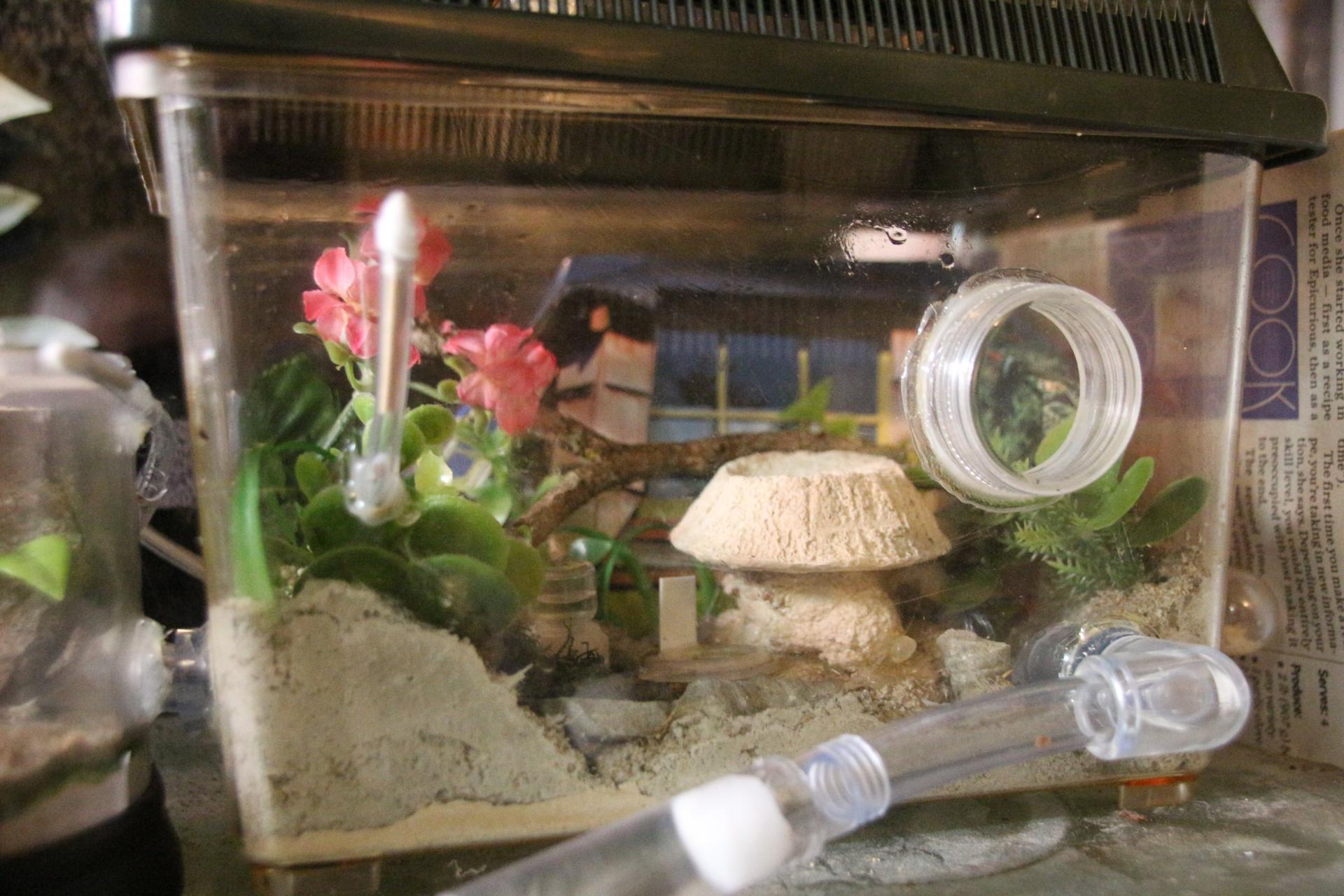
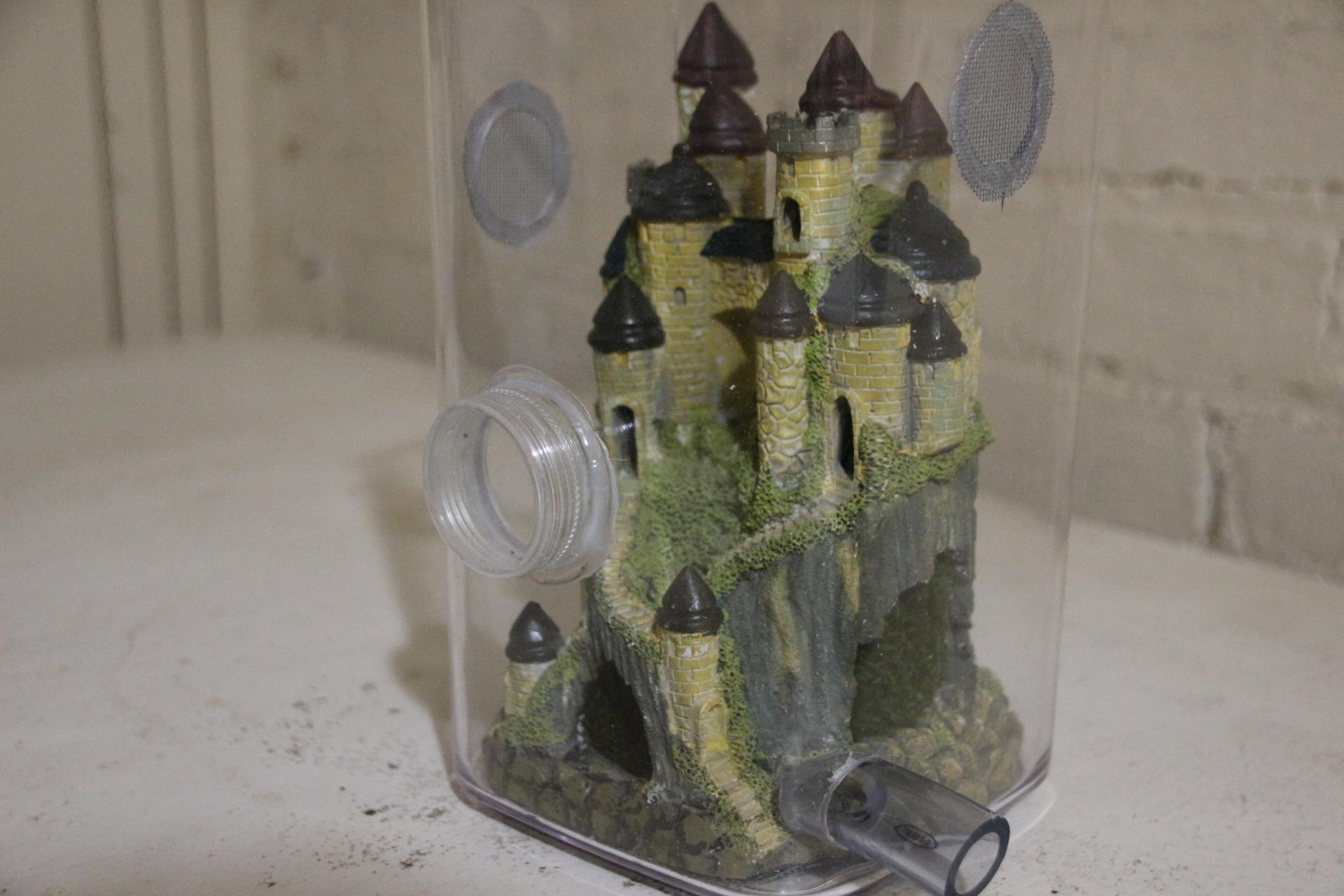
I do have some formicaria that are topped with lids that can't really be fitted with a feeding port, although some have a hinged lid in the top that can be opened and used for feeding and cleaning.   Two are pictured below with front mounted feeding ports.   


IMG_7204.JPG


This setup houses a fairly large Caponotus colony in a single module.    The feeding port is mounted on the front, close to the lid as you've suggested, and the feeding platform is the mushroom shaped structure inside.    Using tweezers, the platform can easily be reached to drop food like chicken on it.    The platform is just far enough away from the feeding port that the ants can't reach it to escape.    A light film of mineral oil on the wall means these poor climbers seldom reach the feeding port.    Usually, they patrol the feeding platform and are only interested in their food.    


IMG_7420.JPG


This is the outworld for a Camponotus colony.    With the feeding port on the front, I can easily reach through with tweezers and place food in the castle feeding area.     These ants also have difficulty climbing on the smooth acrylic walls coated with a very thin, almost invisible, film of mineral oil.   I've had no problems with escapes.     


You've probably read how I feed my colonies a lot of meat products like chicken, turkey, raw pork, salmon and egg yolk.    There's no trash associated with these, and I try to feed each colony just enough for their requirements to reduce the amount of waste.    They usually don't take any more from the feeding tray than they need.


I like using the module system, particularly for fast growing colonies that can eventually become very big.    It would be very difficult to choose a single setup for them, because you really don't know how big the colony will eventually become, so it's difficult to know how big a setup they'll eventually need.    Another problem is that a small colony in a large setup, will often stagnate and fail to thrive for some reason.    Giving them modules as the colony grows gives them room to expand without being excessive.    Another advantage of using modules is that you can decide which ones (presumably those with ants in them) need to be detached and put into winter storage.   


Another thing I've noticed is that the ants (particularly my Tetramorium colonies) use each module for different purposes.    In a mature colony, one module is a queen chamber housing the queen, eggs, and newly hatched larvae.   A second module is used to raise the larvae after they've outgrown the queen chamber.    A third module is used to mature the pupae and a fourth is used for feeding protein, water, and sugar/water.   I've sometimes used long lengths of tubing to connect modules, giving the ants room to roam.    I like to watch them going from module to module as they go about their activities.    


RPT


My father always said I had ants in my pants.


Also tagged with one or more of these keywords: formicaria, fossil, nest, outworld, shark teeth, ammonite, formica, ants, queen

0 user(s) are reading this topic

0 members, 0 guests, 0 anonymous users