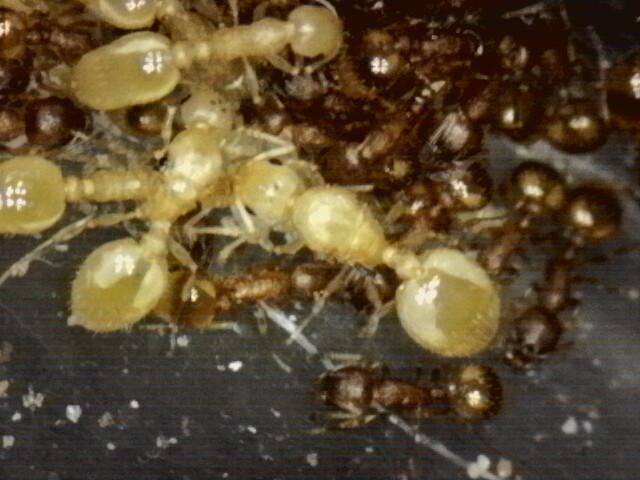
My question is: what exactly are those small white wingless queens? I don’t think they’re alates since they don’t have wings at all.
Attached Images
Edited by AntRealm, November 28 2025 - 10:36 AM.


 Offline
-
Posted November 28 2025 - 10:35 AM
Offline
-
Posted November 28 2025 - 10:35 AM
Advanced Member

Edited by AntRealm, November 28 2025 - 10:36 AM.
Offline
-
Posted November 28 2025 - 10:48 AM
Advanced Member

Today I found this colony, which is probably Temnothorax parvulus.
My question is: what exactly are those small white wingless queens? I don’t think they’re alates since they don’t have wings at all.
Pale means they're just callows. I'm not well-versed with T. parvulus, but wingless callows could mean that those queens don't engage in nuptial flights. I'm likely wrong though.
"Float like a butterfly sting like a bee, his eyes can't hit what the eyes can't see."
- Muhammad Ali
Check out my shop and Formica journal! Discord user is bmb1bee if you'd like to chat.
Also check out my YouTube channel: @bmb1bee
Offline
-
Posted November 28 2025 - 12:08 PM
Advanced Member
Yes, I know they’re newly emerged.But I had heard from a few sources that this species cannot be polygynous,Pale means they're just callows. I'm not well-versed with T. parvulus, but wingless callows could mean that those queens don't engage in nuptial flights. I'm likely wrong though.
Today I found this colony, which is probably Temnothorax parvulus.
My question is: what exactly are those small white wingless queens? I don’t think they’re alates since they don’t have wings at all.
Offline
-
Posted November 28 2025 - 3:05 PM
Advanced Member
Yes, I know they’re newly emerged.But I had heard from a few sources that this species cannot be polygynous,
so that made me doubt it.
It could depend on population. First I've seen of wingless Temnothorax queen callows though.
"Float like a butterfly sting like a bee, his eyes can't hit what the eyes can't see."
- Muhammad Ali
Check out my shop and Formica journal! Discord user is bmb1bee if you'd like to chat.
Also check out my YouTube channel: @bmb1bee
Offline
-
Posted November 28 2025 - 6:23 PM
Member
I'm not to sure if Temnothorax have them, but they could be intercastes.
Currently keeping:
Veromessor Andrei (red varient) x1, Tetramorium immigrans x4, and Solenopsis xyloni x1
Ants I NEED:
Acromyrmex versicolor, Pheidole rhea, any Myrmecocystus
Offline
-
Posted November 29 2025 - 8:54 AM
Advanced Member
 Offline
-
Posted November 29 2025 - 9:25 AM
Offline
-
Posted November 29 2025 - 9:25 AM
Advanced Member
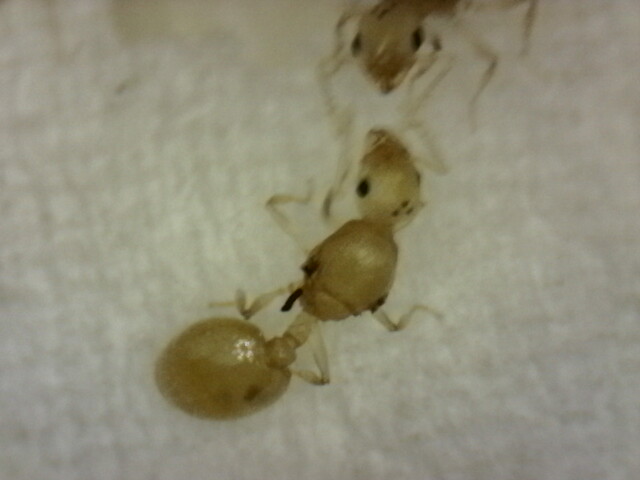
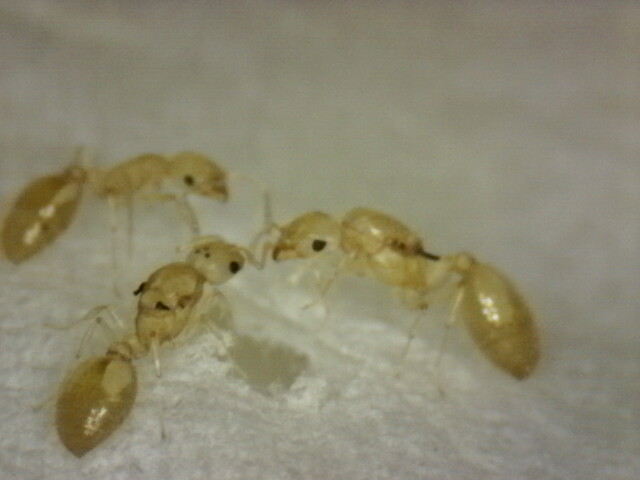
Those three dots are called ocelli; all ants (to my knowledge) have them. They are sometimes called "simple eyes" to differentiate them from the two "compound eyes" we are familiar with.
Edited by Ants_Dakota, November 29 2025 - 9:25 AM.
Go to the ant, you sluggard; consider its ways and be wise! It has no commander, no overseer or ruler, yet it stores its provisions in summer and gathers its food at harvest. -Proverbs 6: 6-8
My Ant Shop Here I have PPQ-526 permits to ship ants nationwide
Attention Ant-Keepers in South Dakota! Join the SoDak(Society Of Dakotan Ant Keepers)
Offline
-
Posted November 29 2025 - 9:54 AM
Advanced Member

Those three dots are called ocelli; all ants (to my knowledge) have them. They are sometimes called "simple eyes" to differentiate them from the two "compound eyes" we are familiar with.
The ocelli's purpose is to distinguish light from darkness. They are the reason ants panic when you check on them, as they are sensitive to light. Their larger eyes can distinguish between objects like our eyes, although they're much more primitive.
"God made..... all the creatures that move along the ground according to their kinds (including ants). And God saw that it was good. Genesis 1:25 NIV version
Keeping:
Tetramorium immigrans Camponotus vicinus, modoc, novaeboracensis, herculeanus
Formica pallidefulva, argentea Solenopsis molesta
Formica cf. aserva Lasius brevicornis, neoniger
Offline
-
Posted November 29 2025 - 11:35 AM
Advanced Member
Those are very strange queens, especially with those vestigial wings like that. I assume they weren't just bitten off or anything?
After doing a bit of research, I agree with An-Ant that those could be intercaste queens, or something similar to it. I found a specific taxa of queens called "brachypterous" queens, where they eclose with very short wings that are often bitten off after emerging, leaving stubs like what we can see in these images. These queens eventually form new colonies through fission, and mating inside the nest, (bmb1bee mentioned this briefly).
The only problem with this is that there are no records from what I've looked into of any temnothorax queens engaging in this behaviour. I know basically next to nothing about this, but this would be my closest guess!
Manica invidia (1 queen, ~200 workers)
Manica invidia (1 colonies, 1 queens plus 3 workers)
Lasius niger (single queen, ~200 workers - naturalistic, predatory set-up)
Lasius americanus (1 colony, ~10 workers)
Tetramorium immigrans (3 colonies, 3 queens, ~ five workers each | 1 colony, 1 queen, ~1200 workers)
Formica aserva (aserva queen, ~15 Formica neorufibarbis workers)
"And God made...everything that creeps on the ground according to its kind.
And God saw that it was good." - Genesis 1:25
Offline
-
Posted December 15 2025 - 12:31 PM
Advanced Member
Offline
-
Posted December 15 2025 - 7:55 PM
Member
Very strange. Perhaps they are lacking a pigment?
With some quick research, I found this Antwiki article: https://www.antwiki....etal_IS2013.pdf
It's on Temnothorax nylanderi. Perhaps what's happening with your colony is similar to this?
The thing that surprises me the most is that the "queens" are still pale white.
Currently keeping:
Veromessor Andrei (red varient) x1, Tetramorium immigrans x4, and Solenopsis xyloni x1
Ants I NEED:
Acromyrmex versicolor, Pheidole rhea, any Myrmecocystus
Offline
-
Posted December 17 2025 - 4:39 PM
Advanced Member
Ok, I guess to figure this out we should probably take a closer look at what exactly the species is. If there's a phenomena like this unique to that species, we can find out quicker and more accurately. AntRealm, could you potentially give us a closer shot of a queen so we can know 100% what species it is?
Very strange. Perhaps they are lacking a pigment?
With some quick research, I found this Antwiki article: https://www.antwiki....etal_IS2013.pdf
It's on Temnothorax nylanderi. Perhaps what's happening with your colony is similar to this?
The thing that surprises me the most is that the "queens" are still pale white.
An-Ant, I think you're correct, they clearly lack pigment. As far as I found out, most queens do not lack pigment except some cryptics with only subterranean lifestyles for the entire colony. So this is not normal. I also read the first bit of the article you mentioned, and you may be right that this could be some sort of accidental intercaste, just based on their lack of pigment and underdeveloped wings.
If this is the case, though, and a queen intercaste is produced, wouldn't the colony cull them off if they're not polygynous?
Manica invidia (1 queen, ~200 workers)
Manica invidia (1 colonies, 1 queens plus 3 workers)
Lasius niger (single queen, ~200 workers - naturalistic, predatory set-up)
Lasius americanus (1 colony, ~10 workers)
Tetramorium immigrans (3 colonies, 3 queens, ~ five workers each | 1 colony, 1 queen, ~1200 workers)
Formica aserva (aserva queen, ~15 Formica neorufibarbis workers)
"And God made...everything that creeps on the ground according to its kind.
And God saw that it was good." - Genesis 1:25
Offline
-
Posted December 17 2025 - 4:50 PM
Member
Those are very strange queens, especially with those vestigial wings like that. I assume they weren't just bitten off or anything?
After doing a bit of research, I agree with An-Ant that those could be intercaste queens, or something similar to it. I found a specific taxa of queens called "brachypterous" queens, where they eclose with very short wings that are often bitten off after emerging, leaving stubs like what we can see in these images. These queens eventually form new colonies through fission, and mating inside the nest, (bmb1bee mentioned this briefly).
The only problem with this is that there are no records from what I've looked into of any temnothorax queens engaging in this behaviour. I know basically next to nothing about this, but this would be my closest guess!
Those are not brachypterous queens. If they were, the mesosoma would not be nearly as large, because brachypterous queens not only have none-functional wings, but also lack wing muscles.
Ok, I guess to figure this out we should probably take a closer look at what exactly the species is. If there's a phenomena like this unique to that species, we can find out quicker and more accurately. AntRealm, could you potentially give us a closer shot of a queen so we can know 100% what species it is?
Very strange. Perhaps they are lacking a pigment?
With some quick research, I found this Antwiki article: https://www.antwiki....etal_IS2013.pdf
It's on Temnothorax nylanderi. Perhaps what's happening with your colony is similar to this?
The thing that surprises me the most is that the "queens" are still pale white.
An-Ant, I think you're correct, they clearly lack pigment. As far as I found out, most queens do not lack pigment except some cryptics with only subterranean lifestyles for the entire colony. So this is not normal. I also read the first bit of the article you mentioned, and you may be right that this could be some sort of accidental intercaste, just based on their lack of pigment and underdeveloped wings.
If this is the case, though, and a queen intercaste is produced, wouldn't the colony cull them off if they're not polygynous?
I'm not sure, but I don't think a colony would cull intercastes. Additionally, even if the colony treated them as queen alates, the colony may not cull them for a few months.
Currently keeping:
Veromessor Andrei (red varient) x1, Tetramorium immigrans x4, and Solenopsis xyloni x1
Ants I NEED:
Acromyrmex versicolor, Pheidole rhea, any Myrmecocystus
Offline
-
Posted Yesterday, 12:48 PM
Advanced Member
Ok, I guess to figure this out we should probably take a closer look at what exactly the species is. If there's a phenomena like this unique to that species, we can find out quicker and more accurately. AntRealm, could you potentially give us a closer shot of a queen so we can know 100% what species it is?
Very strange. Perhaps they are lacking a pigment?
With some quick research, I found this Antwiki article: https://www.antwiki....etal_IS2013.pdf
It's on Temnothorax nylanderi. Perhaps what's happening with your colony is similar to this?
The thing that surprises me the most is that the "queens" are still pale white.
An-Ant, I think you're correct, they clearly lack pigment. As far as I found out, most queens do not lack pigment except some cryptics with only subterranean lifestyles for the entire colony. So this is not normal. I also read the first bit of the article you mentioned, and you may be right that this could be some sort of accidental intercaste, just based on their lack of pigment and underdeveloped wings.
If this is the case, though, and a queen intercaste is produced, wouldn't the colony cull them off if they're not polygynous?
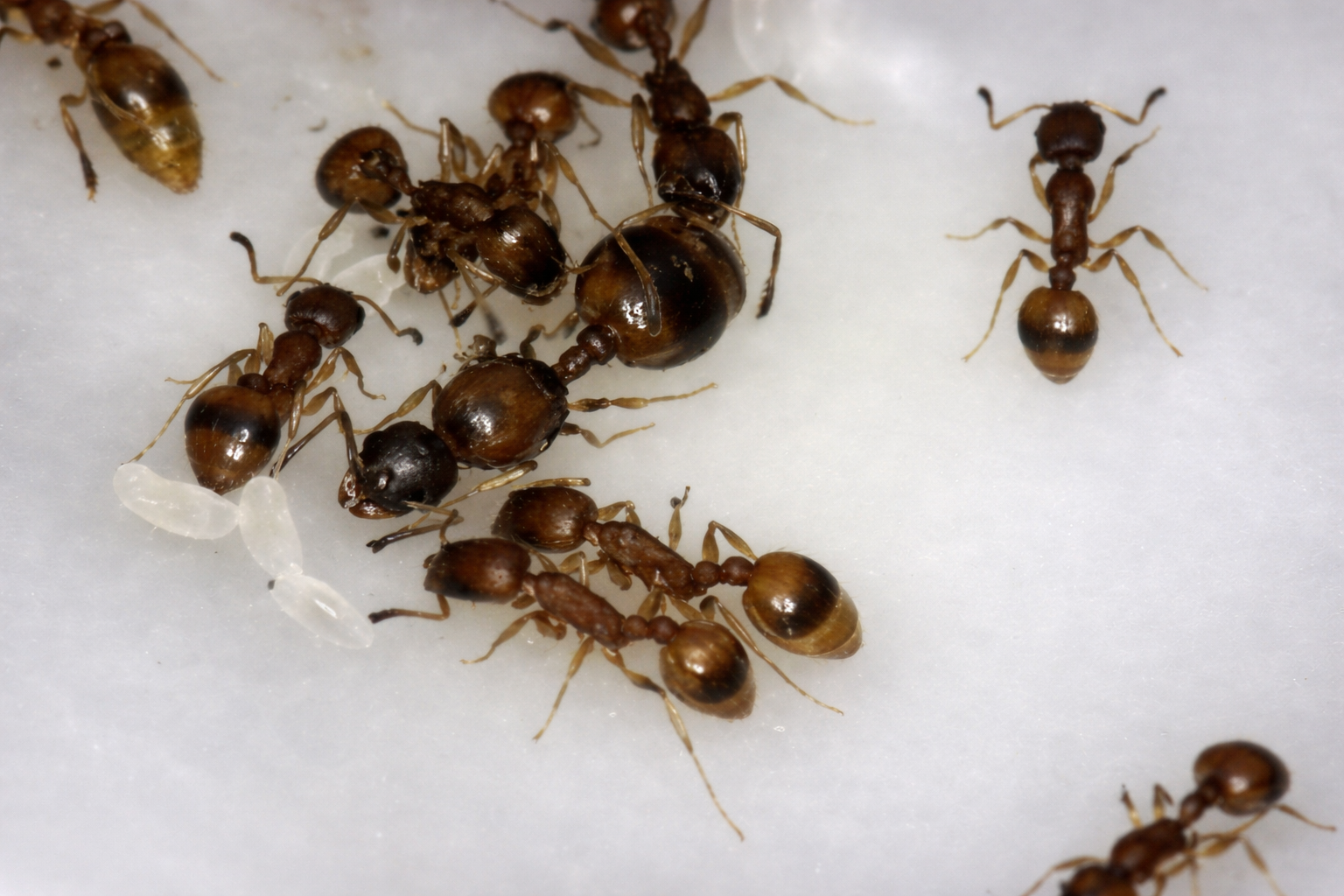
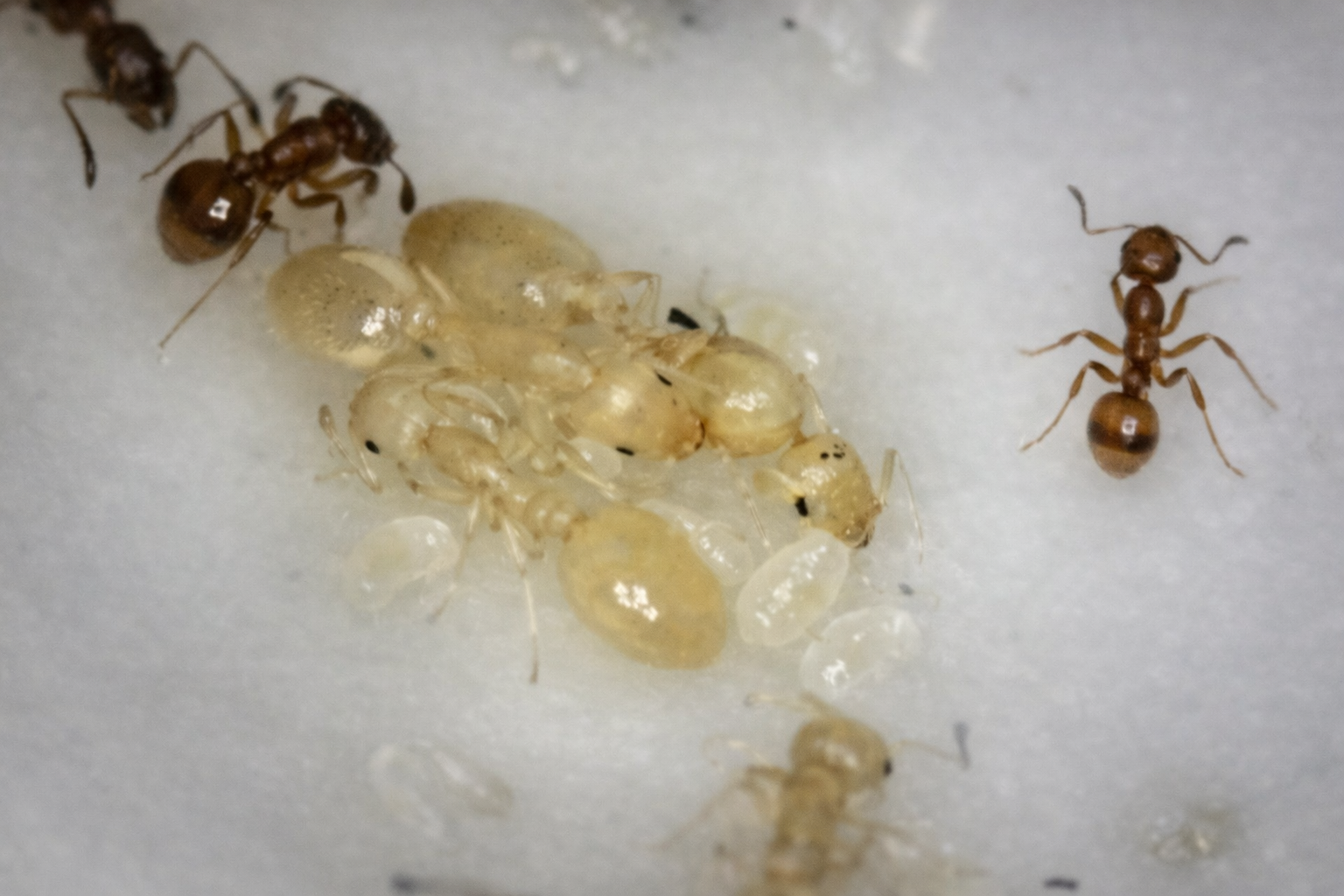
 Offline
-
Posted Yesterday, 3:08 PM
Offline
-
Posted Yesterday, 3:08 PM
Advanced Member
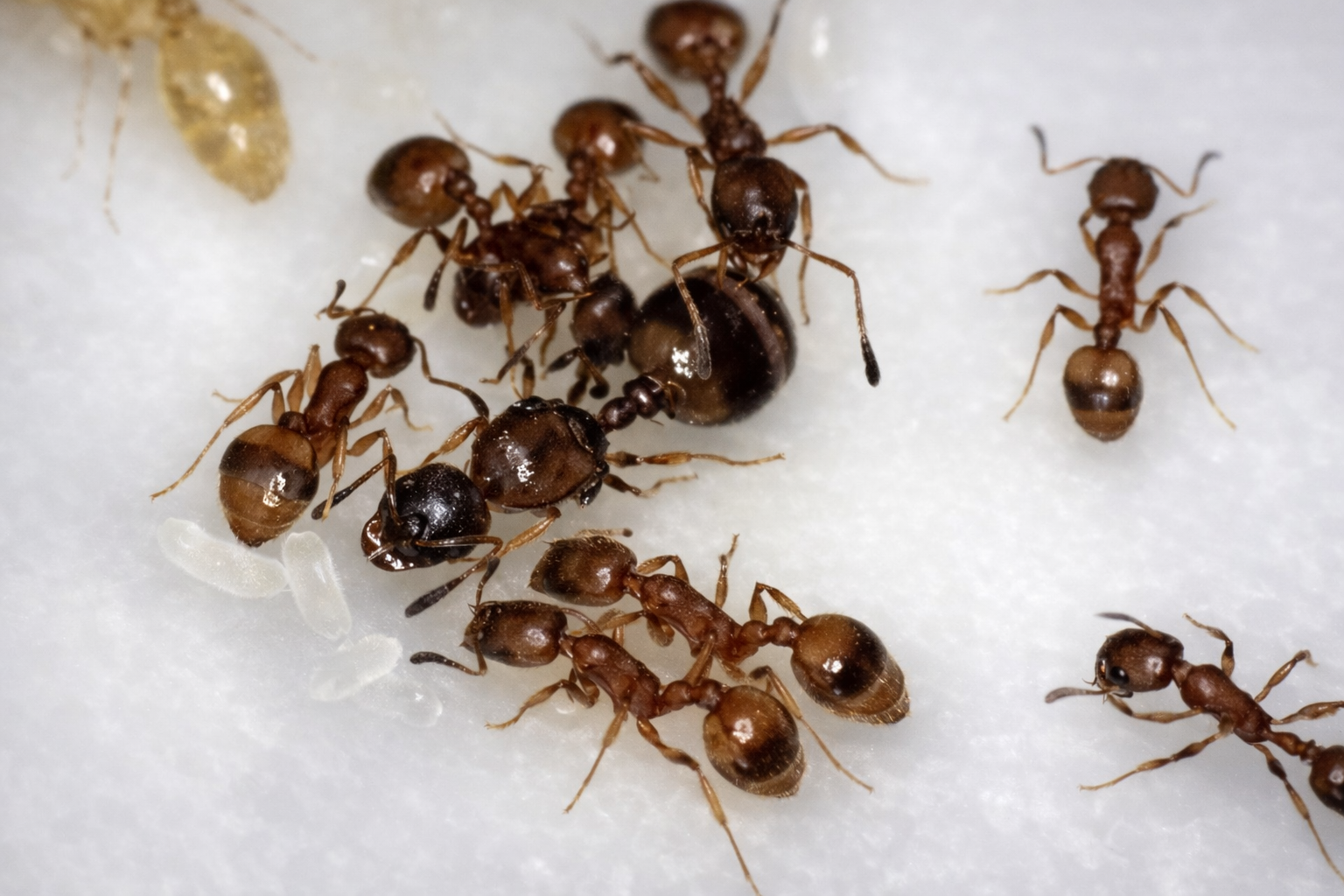
Thanks AntRealm! Ok can we confirm this ID? Beautiful photos by the way.
Manica invidia (1 queen, ~200 workers)
Manica invidia (1 colonies, 1 queens plus 3 workers)
Lasius niger (single queen, ~200 workers - naturalistic, predatory set-up)
Lasius americanus (1 colony, ~10 workers)
Tetramorium immigrans (3 colonies, 3 queens, ~ five workers each | 1 colony, 1 queen, ~1200 workers)
Formica aserva (aserva queen, ~15 Formica neorufibarbis workers)
"And God made...everything that creeps on the ground according to its kind.
And God saw that it was good." - Genesis 1:25
Offline
-
Posted Yesterday, 4:48 PM
Advanced Member
Thanks. Actually, I tried to use artificial intelligence to increase the quality so they would be clearerThanks AntRealm! Ok can we confirm this ID? Beautiful photos by the way.
Offline
-
Posted Yesterday, 5:37 PM
Member
Ok, I guess to figure this out we should probably take a closer look at what exactly the species is. If there's a phenomena like this unique to that species, we can find out quicker and more accurately. AntRealm, could you potentially give us a closer shot of a queen so we can know 100% what species it is?
Very strange. Perhaps they are lacking a pigment?
With some quick research, I found this Antwiki article: https://www.antwiki....etal_IS2013.pdf
It's on Temnothorax nylanderi. Perhaps what's happening with your colony is similar to this?
The thing that surprises me the most is that the "queens" are still pale white.
An-Ant, I think you're correct, they clearly lack pigment. As far as I found out, most queens do not lack pigment except some cryptics with only subterranean lifestyles for the entire colony. So this is not normal. I also read the first bit of the article you mentioned, and you may be right that this could be some sort of accidental intercaste, just based on their lack of pigment and underdeveloped wings.
If this is the case, though, and a queen intercaste is produced, wouldn't the colony cull them off if they're not polygynous?
Is it just me, or does only one of the "queens" have ocelli and wing muscles? This probably confirms these are intercastes.
As for IDs, could you provide us with a general location where these were found?
Currently keeping:
Veromessor Andrei (red varient) x1, Tetramorium immigrans x4, and Solenopsis xyloni x1
Ants I NEED:
Acromyrmex versicolor, Pheidole rhea, any Myrmecocystus
Offline
-
Posted Today, 2:20 AM
Advanced Member
Iran, south of the Caspian Sea. Found in a forested area with soft soil. They were discovered under a rotting bag, near an Aphaenogaster colony—actually very close to it, near the aggregation chamber.Is it just me, or does only one of the "queens" have ocelli and wing muscles? This probably confirms these are intercastes.
Ok, I guess to figure this out we should probably take a closer look at what exactly the species is. If there's a phenomena like this unique to that species, we can find out quicker and more accurately. AntRealm, could you potentially give us a closer shot of a queen so we can know 100% what species it is?
An-Ant, I think you're correct, they clearly lack pigment. As far as I found out, most queens do not lack pigment except some cryptics with only subterranean lifestyles for the entire colony. So this is not normal. I also read the first bit of the article you mentioned, and you may be right that this could be some sort of accidental intercaste, just based on their lack of pigment and underdeveloped wings.Very strange. Perhaps they are lacking a pigment?
With some quick research, I found this Antwiki article: https://www.antwiki....etal_IS2013.pdf
It's on Temnothorax nylanderi. Perhaps what's happening with your colony is similar to this?
The thing that surprises me the most is that the "queens" are still pale white.
If this is the case, though, and a queen intercaste is produced, wouldn't the colony cull them off if they're not polygynous?
As for IDs, could you provide us with a general location where these were found?


0 members, 2 guests, 0 anonymous users

Community Forum Software by IP.Board
Designed By skinod.com

